


A person on the autism spectrum leaves a file-sharing program running overnight because they want cartoons or anime. By morning, thousands of images have been downloaded onto their hard drive, some of them child sexual abuse material they never chose and, in some cases, never even opened. Months later, the FBI is at the door. A judge stares at the download count and asks how anyone could not understand what they were doing.
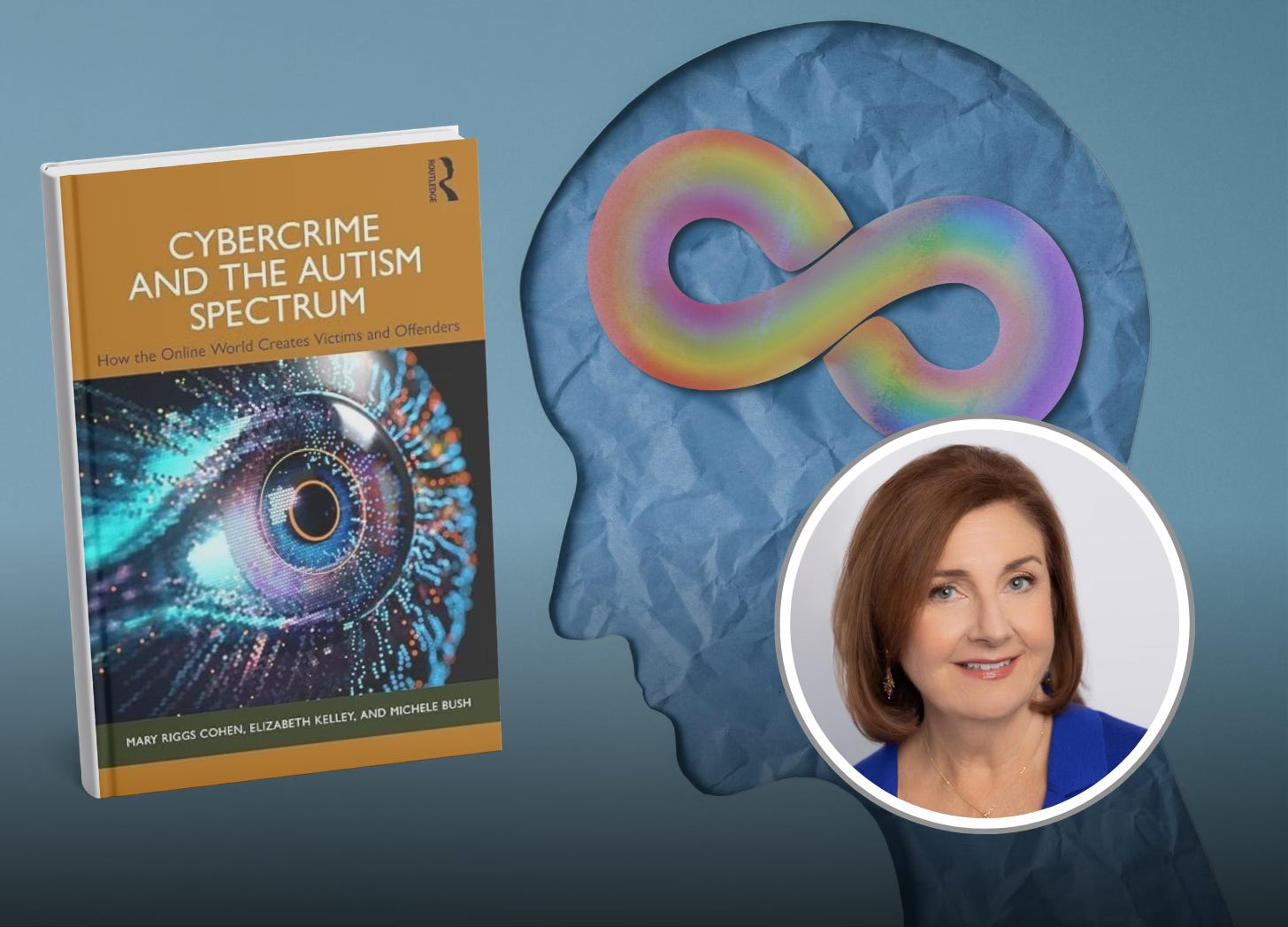
My recent guest on Cults, Culture & Coercion, Dr. Mary Riggs Cohen, spends her working life answering that question in courtrooms across the country. She is a clinical psychologist with thirty years of experience, specializing in autism spectrum disorders, and has conducted forensic evaluations of autistic defendants since 2009. Her new book, co-written with defense attorney Elizabeth Kelley and digital forensics expert Michele Bush, is Cybercrime and the Autism Spectrum: How the Online World Creates Victims and Offenders. I met Dr. Cohen at the International Academy of Law and Mental Health Congress in Montreal, and I asked her on the show the moment her presentation ended, because so much of what she described maps directly onto the recruitment tactics I have studied for five decades.
Victims and Offenders, Often the Same Person
Dr. Cohen’s first point cuts against the instinct to sort people into predators and prey. “Most people on the spectrum are both victimized and offenders at some point,” she told me. Cyberbullying, financial scams, and sexual exploitation run in one direction. Chat rooms that ask for “a picture of a child in your family” run in the other, quietly moving an autistic person into possession of CSAM they may never have sought out. Child sexual abuse material (CSAM) is not “child pornography.” It’s evidence of child sexual abuse—and it’s a crime to create distribute or possess. CSAM includes both real and synthetic content such as images created with artificial intelligence tools. Because many autistic individuals catalog and organize obsessively, agents who search a seized computer often find the material sorted into folders, which reads to an outsider as intent rather than what it frequently is: a hyperfocus trait turned against the person who has it.
The Theory of Mind Trap
The mechanism connecting both roles is a concept known as “theory of mind”, the capacity to perceive what another person actually wants from an interaction. “They’re not always thinking about what may be going through the head of the person who’s telling them something,” she said. An autistic person is also, by the research and her clinical experience, less inclined to lie, which makes them easy to read and easily become a target. Age stops functioning as a filter, too. A forty-year-old and a fourteen-year-old sharing an anime forum can register, socially, as peers. That combination, sincerity plus a flattened sense of who is “supposed” to be a friend, is exactly what predatory groups are built to exploit, whether the predator is a stranger in a Discord server or the leader of an ideological movement.
I described watching a similar dynamic while helping develop Ending the Game, the program Rachel Thomas, Carissa Phelps created to help female sex trafficking survivors understand why they kept returning to the pimps who had recruited them. A trafficker who buys someone flowers and says “I love you” is transacting, not attaching. Dr. Cohen sees the same script online. “Everything that you’re saying, I want to just make this point: people with autism see the world through a different lens,” she said, and that lens, combined with a lifetime of exclusion and bullying that many autistic people carry, leaves them starved for the acceptance a bad actor is happy to fake.
Black-and-White Thinking Is the Cult’s Opening
This is where her work and the BITE Model of Authoritarian ControlTM intersect most directly. Autistic individuals, Dr. Cohen explained, are frequently drawn to the same all-or-nothing framing that fuels incel forums, white supremacist groups, and jihadist recruitment. “It’s taking something very complex and boiling it down,” she said, and for someone exhausted by a confusing social world, that simplicity is a relief rather than a red flag. She has read reports of extremist groups deliberately recruiting autistic people for their technical skills, promising purpose and belonging in the same breath. I brought up my own past conversation with Dr. Tony Attwood, who told me autistic people love the concrete, checklist-style logic of the Influence Continuum and the BITE Model, working down the list of controls includes manipulating sleep, food, and contact with family until a group reveals itself as dangerous. Dr. Cohen agreed that the appeal runs both ways. A simplified, radical worldview can offer the same relief, she said, because “I don’t have to make those decisions today.”
What the Courtroom Gets Wrong
Masking, the exhausting daily performance of appearing to understand social context, becomes a legal liability. Dr. Cohen described autistic defendants nodding “yes, yes, yes” to a judge’s questions while their own attorney knows they do not understand what is being asked. Sensory sensitivity and overload compounds it. Courtrooms are loud, fluorescent-lit, and unpredictable, and she has had to request headphones for clients simply to keep them regulated during their own hearings. She now spends much of her time coaching attorneys who, until sitting through one of her workshops, had no idea how many of their past clients were autistic and undiagnosed.
Victims, Not a Profile
Dr. Cohen was emphatic on one point I asked her to underline: autistic people are far more likely to be victimized than to commit violence, and the panic after cases like Sandy Hook, when children in autism support classes were bullied over unfounded fears, did real damage. Her advice to families is direct: pursue a specialized autism evaluation, not an online quiz, if you suspect a late diagnosis. Talk to your children about sexuality, not just reproduction, before the internet does it for you. And treat any online “friend” who says don’t tell your parents exactly like the warning sign it is.
I am grateful to Dr. Cohen for the work she does evaluating autistic individuals, testifying, training attorneys, and writing a book meant to be read by parents, clinicians, and autistic adults alike. Watch our full conversation below, and if you love someone on the spectrum, share it with them.
Further Reading and Resources
Dr. Cohen’s website and visit her on Instagram and LinkedIn
Autism, Extremism, and Protecting the Vulnerable with Dr. Tony Attwood - My earlier conversation with the world’s foremost Asperger’s researcher on black-and-white thinking, certainty, and radicalization.
She Spent $115K in a Wellness Cult with Brandie Hadfield - A mother with undiagnosed ADHD and an autistic son on a decade lost to a commercial cult.
Cybercrime and the Autism Spectrum: How the Online World Creates Victims and Offenders - Dr. Cohen’s book with Elizabeth Kelley and Michele Bush.
AANE: Directory of Asperger/Autism Diagnosticians - For families seeking a specialized autism evaluation.
Asperger’s/Autism Spectrum Disorder and Undue Influence - My earlier writing on this intersection.
This is very informative!
This is interesting and enlightening.