


Carlos Castaneda sold more than 10 million books to readers who thought they were buying anthropology. Real fieldwork. A real Yaqui shaman named Don Juan, teaching a real Westerner how to see. None of it happened. Castaneda made it up, and for years almost nobody in the press called him on it.
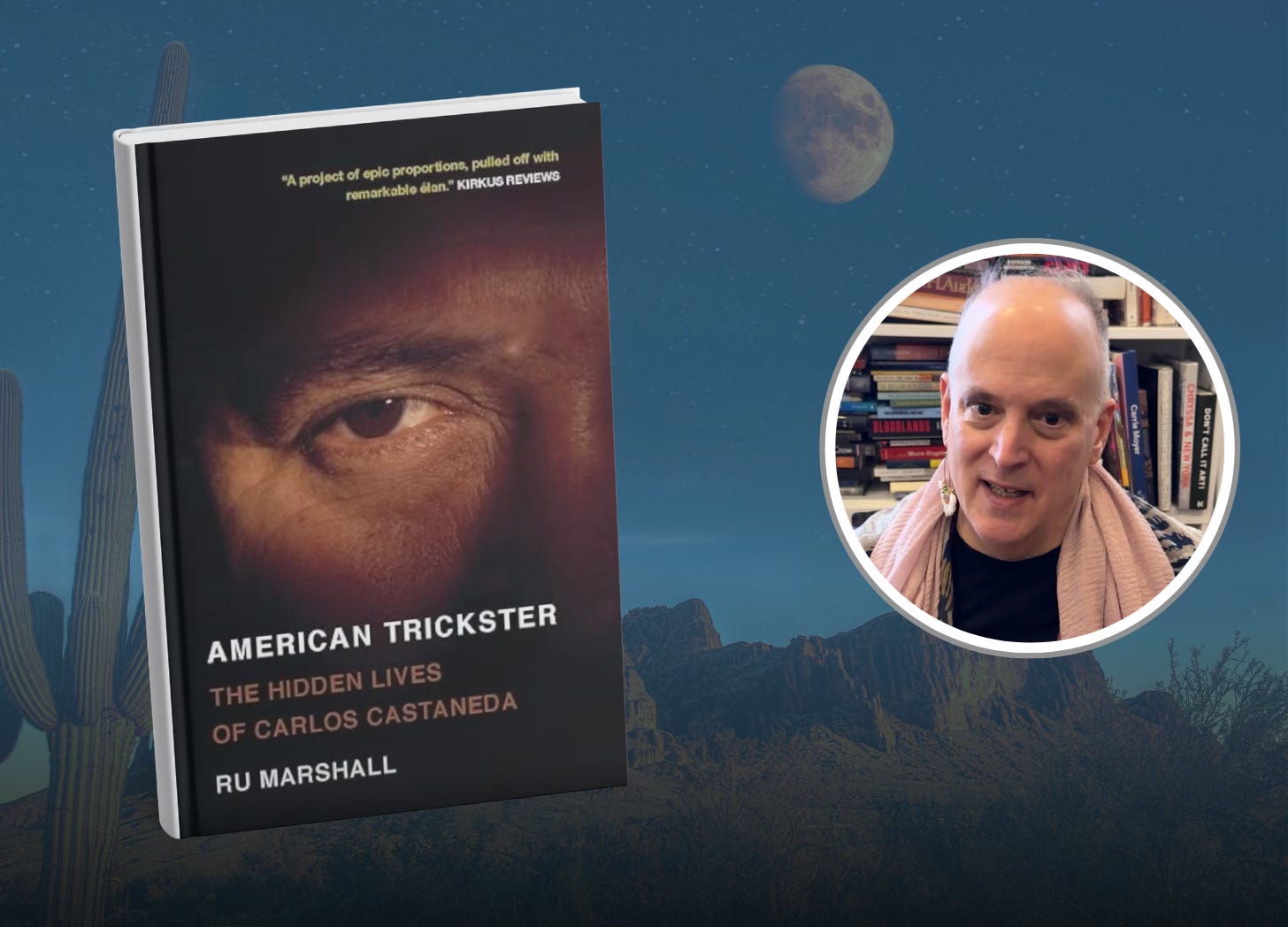
I read all of those books as a teenager. Grew up on them, the way a lot of people my age did, right alongside Kung Fu reruns and books about Gurdjieff my neighbor suggested I read. So, when I heard that Ru Marshall, a nonbinary writer and artist I met years ago at a cult conference, had just published a full biography of the man, I wanted them on the podcast immediately. The book is called American Trickster: The Hidden Lives of Carlos Castaneda, and it took Marshall almost twenty years to write it.
Here’s the part most casual fans never learn. While Castaneda was cranking out sequels, he was also running an actual cult, a small group of women out of a house in Westwood that he called his witches. That story ends with human remains found in Death Valley. I’ll get there.
The Book UC Press Still Won’t Call Fiction
Castaneda published The Teachings of Don Juan: A Yaqui Way of Knowledge with the University of California Press in 1968. Peyote, datura, mushrooms, a secret indigenous wisdom no outsider had ever seen. It went from underground favorite to full-blown international bestseller inside a few years. John Lennon loved it. So did Fellini. Octavio Paz, who’d go on to win the Nobel Prize, wrote the foreword to the Spanish edition. The New York Times and Harper’s ran glowing reviews.
Nobody in a position to matter said a word for about five years. Then in 1972 the novelist Joyce Carol Oates wrote to the Times, more or less asking whether she was the only person who noticed these read exactly like novels. She wasn’t wrong, and Marshall told me flatly: “he basically made it all up.” There was no single moment where he got caught, nothing like the James Frey pile-on. Academics started quietly backing away over the years that followed, even while a few university programs kept assigning him.
And here’s the detail that got me. Castaneda’s actual PhD advisor at UCLA was a sociologist named Harold Garfinkel, the founder of a field called ethnomethodology. Garfinkel’s core idea, that “reality is an agreed-upon description,” shows up almost word for word out of Don Juan’s mouth. Castaneda didn’t invent a philosophy. He put his own professor’s theory into a fake shaman’s voice and called it field research.
You’d think a university press would want distance from that by now. Marshall had a contract to publish American Trickster through UC Press, until it went out for review to a sociologist of religion who objected to the word “cult” in the manuscript, and soon after, the deal died. Meanwhile, UC Press keeps The Teachings of Don Juan in print. Still shelved as cultural anthropology. “That’s a sin,” I told Marshall when I heard it, and I meant it. There is a company right now making money off a book they know is fiction, dressed up as somebody else’s culture.
The Witches
While the books sold, Castaneda quietly built his group. Florinda Donner-Grau. Taisha Abelar. Kylie Lundahl. Amalia Marquez. And Patricia Partin, whom he’d taken in as a teenager and renamed Nuri Alexander, telling people she was his adopted daughter from another dimension.
Nobody outside that circle knew what he looked like. That’s not an exaggeration, Marshall said, he may have been the most secretive famous writer of the whole twentieth century. Then, starting in the late eighties, the women suddenly went public, holding seminars, teaching a movement they called tensegrity, which they claimed came down through twenty-five generations of Toltec shamans. Marshall pointed out the obvious problem: the Toltecs vanished five hundred years ago. The word itself, tensegrity, Castaneda lifted straight from Buckminster Fuller.
Castaneda told the group he wouldn’t die. He’d become a ball of light. Instead, he got liver cancer, and on April 27, 1998, he died, though nobody announced it publicly for weeks. By the time anyone found out, five of the women closest to him were already gone. In 2003 hikers came across skeletal remains out in Death Valley. They were identified as Patricia Partin. The other four have never turned up, not their cars, not a single financial record, nothing.
Marshall used the word “mind-blowing” more than once talking about this part, and I don’t think that’s overstating it. These weren’t naive people. Some of them had been enrolled in UCLA’s own anthropology program. One finished a doctorate. And they still followed him into what looks, from every angle anyone’s been able to piece together, like a group departure none of them survived.
Smart People Fall For This Too
Here’s what stuck with me most from our conversation. Marshall kept pushing back on the idea that this happens to gullible people. His first devoted follower worked in the rare book room at UCLA’s library. Later ones were grad students, professionals, people with real credentials. “It’s not stupid people,” Marshall told me. “It’s people who are vulnerable in just the ways everyone is vulnerable at a certain moment in their life.”
I’ve said some version of that for forty years and I still had to sit with it for a second, hearing it applied to a story I grew up reading. Being smart doesn’t protect you. What Castaneda offered his followers, you’re chosen, you’re special, there’s a knowledge here nobody else gets, is the same offer every cult leader I’ve ever studied makes. He just wrapped it in better prose than most of them.
Amy Wallace knew that offer from the inside. She was the daughter of the bestselling novelist Irving Wallace, and Castaneda pursued her for two decades before she finally joined his circle, eventually claiming he could put her in contact with her dead father’s spirit. Her 2003 memoir, Sorcerer’s Apprentice: My Life with Carlos Castaneda, is where Marshall’s own research started. One phone call turned into a three-hour conversation, and that turned into twenty years of work.
What Marshall Wants You to Take From This
Marshall isn’t asking anyone to pull the book from shelves. What they want is honesty: publish it as a novel, or at the very least, stop calling it anthropology. Actual shamanic tradition, Marshall reminded me, is built around community and healing. Castaneda’s version was built around personal power, which tells you everything about how little it had to do with the culture it claimed to represent. Castaneda himself was born in Peru and spent most of his adult life denying it.
I don’t think the parallel to where we are now needs much spelling out. Certainty sells. Tell someone they’re one of the chosen few, that everyone around them is holding them back, that belief alone can bend reality, and you’re running the same play whether you’re sitting across a campfire or standing at a podium. Marshall’s book isn’t going to make UC Press pull The Teachings of Don Juan off the shelf. But it makes it a lot harder for anyone to claim they were never told.
Further Reading
American Trickster: The Hidden Lives of Carlos Castaneda by Ru Marshall (June 23rd 2026)
Sorcerer’s Apprentice: My Life with Carlos Castaneda by Amy Wallace (2007)
In the Shadow of Enlightenment: A Girl’s Journey Through the Osho Rajneesh Cult — Sarito Carroll’s account of growing up inside another charismatic guru’s inner circle.
Holy Hell Documentary Shows How Cult Leader Raped Followers for Years — How a failed actor built a cult around a fabricated enlightened persona.
Rama Trauma Trump: I Left the Cult and Now Look What Happened, with Author Mark Laxer — A former member’s account of Frederick Lenz, another self-mythologizing guru of Castaneda’s era.
What Makes Narcissism “Malignant” and Why It Matters for Your Safety — The clinical framework behind the personality type Castaneda and leaders like him share.
The Truth About Sun Myung Moon — On the gap between a charismatic founder’s public myth and the documented reality.
I question his characterization of Castaneda as brilliant and charismatic. I knew someone who knew Castaneda personally and described him as quiet, private, kind of stiff, and suit and tie straight.
Interesting article covers a lot of ground and yes if ultimately if not connected to real indigenous people than should be re-categorized as fiction yet still somehow at the same time inspired people to question the consensus of what is reality which inspired many a people's personal quest for meaning and didn't require anybody to join or pledge themselves to so ultimately had some good effects besides the negatives you point out.