


In today’s digital age, online pictures and postings can be used as legal evidence, text messages are commonly admissible in court, and personal movements are easily tracked. These factors make divorce from a controlling partner an incredibly challenging process, mainly when children and custody disputes are involved. Despite persistent myths that women are more often favored, family courts can be gender-biased, and some women who report abuse encounter even harsher outcomes. Additionally, premeditated manipulation involving paid professionals can further complicate cases of emotional and physical abuse. Claims of parental alienation are increasingly used in such disputes. Meet two experts in coercive control!
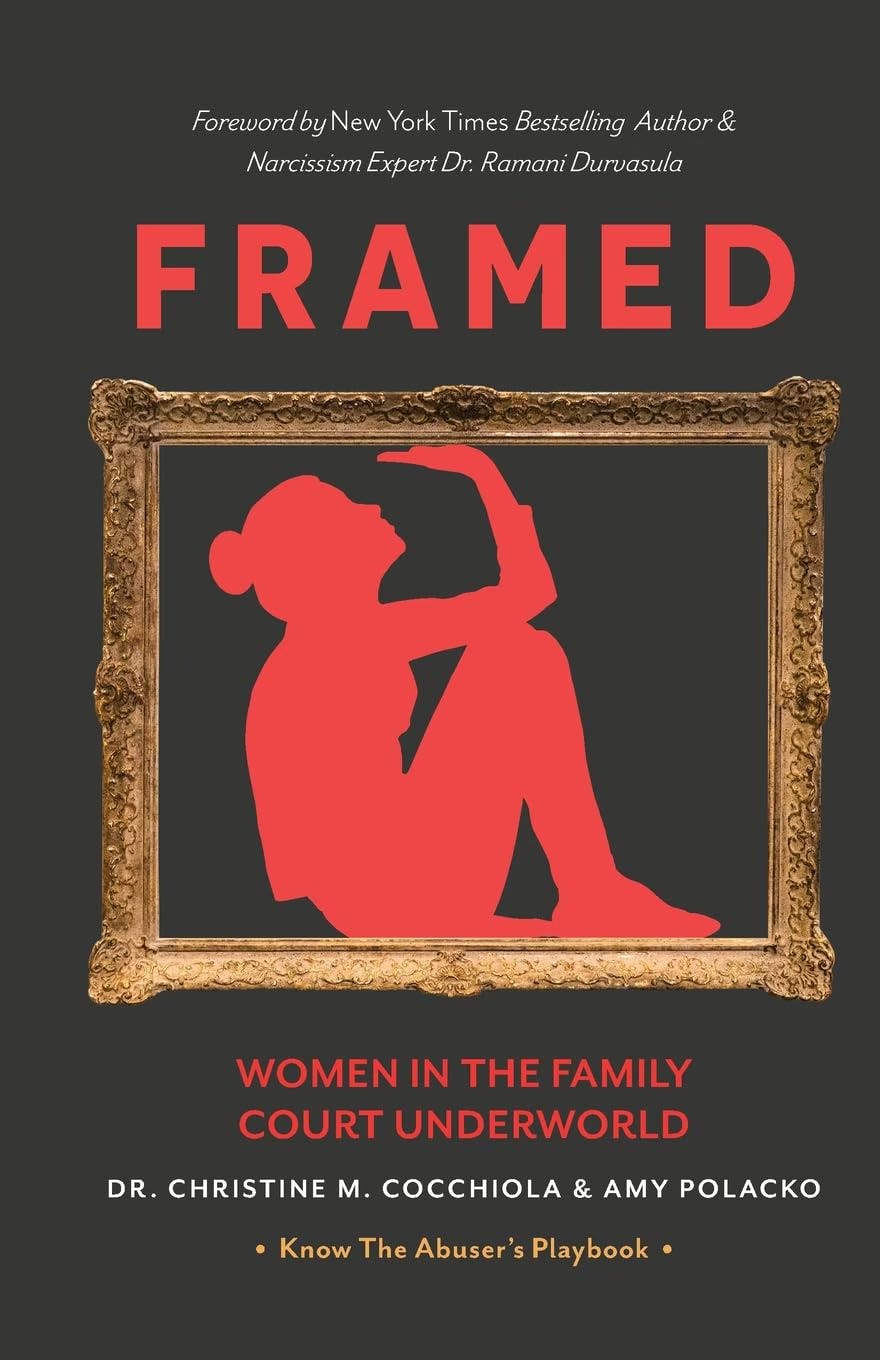
Dr. Christine M. Cocchiola and Amy Polacko address these critical issues in their book Framed: Women in the Family Court Underworld, a collection of 22 case studies highlighting the experiences of protective mothers and their children navigating the complex family court system. The book is a resource for women going through divorce, married women noticing early warning signs, and those considering marriage, offering practical advice and raising awareness of systemic challenges. The authors aim to inspire reform in family court practices and contribute to future legislative efforts to protect women from abusive legal dynamics.
Dr. Cocchiola holds a doctorate in social work, is a licensed clinical social worker, is a tenured college professor, and has been a social justice advocate since age 19, working as a domestic abuse and sexual assault counselor and child welfare advocate. She is a Coercive Control Educator and a prior National Coalition Against Domestic Violence board member. Amy Polacko, an award-winning journalist and investigative reporter, is a divorce coach and founder of Freedom Warrior Coaching, which empowers women before, during, and after divorce. Polacko holds a master’s degree from Columbia University’s School of Journalism. She believes women must be the CEO of their own divorce and is the creator of the digital course “Divorce Decoded.”
A Broken Family Law Court System
Family law courts seldom protect the most vulnerable in the ways that psychological communities have proven optimal. Children who have been victims of or witnessed abuse deserve protection. Dr. Cocchiola noted that the courts often use the “violent incident model” to prove harm. This “frame” is problematic as it often focuses on isolated episodes of violence rather than recognizing patterns of ongoing control or coercion. This model can often result in the minimization of harm because the victim must prove each violent incident separately.
“When abuse is covert, it is challenging for victims themselves to recognize their own loss of autonomy, and even when there is overt coercive control in the form of physical violence or sexual violence, verbal assaults and stalking, the experiences are diminished by family court with adult victims of abuse disbelieved for their own abuse and disbelieved at a greater rate when the perpetrator has abused the children,” Dr. Cocchiola read from the introduction to their book.
Amy then told us how the book mapped out “the abuser’s playbook.” She told the story of Michelle, who has been trying to get a divorce for five years. Her account said she was over $300,000 deep into legal fees and personal debt. “He isolated me from family and limited my friendships. But one day, I visited a friend out of town and told her how he woke the kids up in the middle of the night to tell them your mother’s a whore and a bitch. I’ll never forget the look on my friend’s face when hearing this and her adamant warning: you’ve got to get out of there,” Amy read from Michelle’s account in the book.
I noted the importance of talking to friends outside the immediate dynamic to give perspective. Also, women are often given fantasy versions of relationships in our male-dominated culture. I encouraged couples to use this book as a conversation starter for potential spouse relationships, even reading the book together. “And if the person freaks out, then, you know, you don’t want to marry this person,” I said. We discussed how books like this give people a place to find quality information and provide a foundation for further discussion.
Guiding Children Safely Through Divorce
Dr. Cocchiola stressed the importance of not sheltering children too much from the reality of divorce when abuse occurs. Though she noted that never disparaging the abuser is encouraged, she also stated that it is essential to avoid what she called intuition disintegration. “We are literally disintegrating their intuition like they are not able to truly feel at their core what is going on because we keep, in some ways, suppressing that,” she said. She later explained, “There’s a way to call out behaviors without ever disparaging the abuser, especially moms who are engaged in family court.” She encouraged avoiding gaslighting kids by trying to cover up for the abuser with a false reality not to cause the children harm. She noted that the result here was often that the children are being trained not to trust their own innate feelings about safety and harm.
Family Courts Reality Explained
Amy reminded listeners that many times, people going through the Family Court system were unaware of the reality of the process. They came in with a conception that the system would hear their case fairly or that some television portrayal of how justice works would play out. Instead, she noted that often, the attorneys themselves would become abusers of the already vulnerable participants.
Dr. Ramani Durvasula, who wrote the forward for the book, often calls this system the Industrial Divorce Complex. “Lawyers are not necessarily interested in figuring out who the abuser is. I mean, this is the problem, and there’s money to be made in family court, and the longer I’m engaged in the family court system, the longer, the more financial abuse I’m going to suffer,” said Dr. Cocchiola. Additionally, there are complications to the system, such as reunification camps that can be ordered through family courts to attempt to reconcile children with abusive parents forcibly. She noted how traumatic this forcible fracturing of attachment to the safe parent can be to the child. I stated that I felt this was like boot camp cults, which are commonly about money vs. caring about children.
Progress in the Family Courts
Coercive control has been criminalized in many countries, including the UK, Ireland, Scotland, Wales, and England. Canada is also moving toward criminalizing these behaviors. The United States has codified it as a form of domestic abuse, but it has not yet been criminalized in all states. In California and Hawaii law, coercive control can be considered a misdemeanor.
Amy also noted Kayden’s Law, which requires courts to consider the history of abuse when making custody decisions. The law also addresses definitions of abuse. Factors such as parents protecting themselves from abuse may be differentiated from parents showing an unwillingness to cooperate with the other party. Domestic abuse advocates note that laws such as these are needed to substantially change how domestic abuse is handled in family courts going forward.
Wrapping up, I noted the importance of reading this book, not only to provide protection through knowledge but also to learn how we can advocate for future laws surrounding domestic abuse so that children and families going through family courts can be better protected.
Resources:
Dr. Hassan, I want to thank you for all the great and tireless work that you've been doing for 4 decades to help people de-program from mind control--whether it's from cult organizations or the "cult of one." Having been involved with multiple cultish organizations as well as coercive and abusive relationships, I find this podcast episode particularly pertinent and helpful. Even though I don't have children and never went to a family court because my former partner and I weren't married, I resonate with all the relationship dynamics discussed in this episode. I've shared it with my fellow "chumps"--a huge community of people who have been cheated on by intimate partners, and many appreciated being introduced to such in-depth and profound work that they can resonate with. It's often the case that the cheating itself is a symptom of coercive abuse rather than a stand-alone problem. I can't thank you, Dr. Cocchiola and Amy Polacko enough for delving into these complex subjects and shedding light on the common thread among them.