


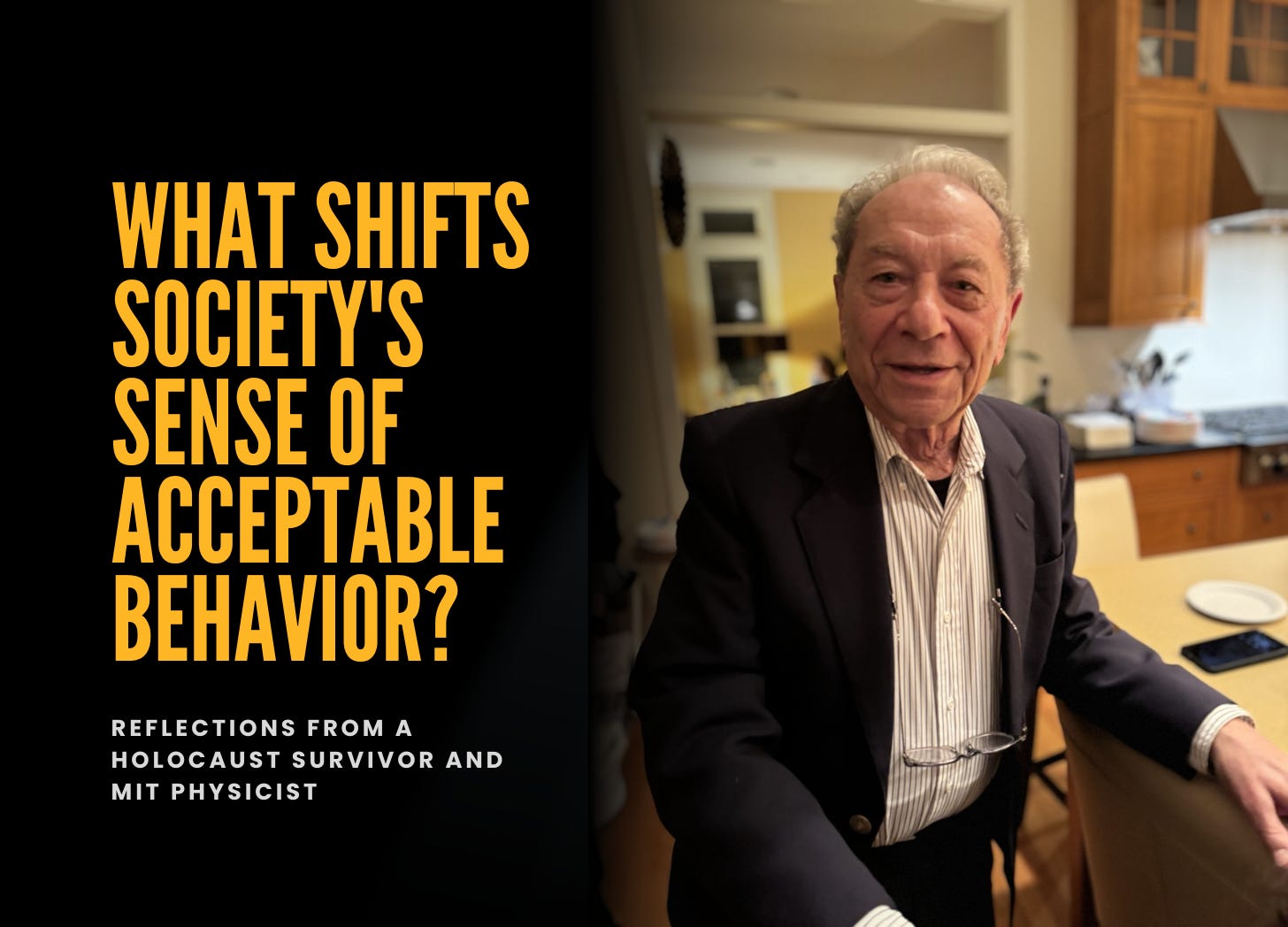
I would like to share this essay written recently by my beloved 98-year-old father-in-law for thoughtful people to read, reflect, and hopefully share with others who wish to have wisdom from one of the smartest, kindest, most loving people I have been blessed to know since 1980.
When I first met his daughter Aureet Bar-Yam, and fell in love, he was a physicist with a PhD from MIT, teaching physics at U Mass Dartmouth where he became head of the department while simultaneously conducting research at Brookhaven National labs. His son, Yaneer Bar-Yam later got his PhD from MIT in physics and went on to found and direct the New England Complex System Institute (necsi.edu). Yaneer taught me the basics of complex systems, held conferences, invited me to teach and because of him helped me to develop my Strategic Interactive Approach (SIA) that I wrote about in my book, Freedom of Mind: Helping Loved Ones Leave Controlling People, Cults and Beliefs.
1. The Question
For many years after the Second World War, I chose not to speak about my experiences during the Holocaust. I had survived the Kraków Ghetto, escaped twice through the city’s sewer system, and eventually survived the war. Yet I could see no constructive lesson to be drawn from what had happened. Remembering horror did not, by itself, seem to tell us how to prevent its recurrence.
That attitude changed in 1991. My daughter confronted me with the consequences of my silence. She told me, in effect, that the void created by not knowing was worse than knowing the past. I promised then to take my children to Kraków and show them where our family had lived, suffered and escaped. I kept that promise.
For many years thereafter, my concern was principally remembrance: to preserve testimony, establish historical facts, and make certain that subsequent generations would know what had happened.
More recently, another change occurred.
During visits to Holocaust memorials in Warsaw and Kraków, and particularly while responding to detailed questions posed by a Holocaust historian, I found myself asking a different question. The Holocaust was not produced by a natural disaster. Human beings created the institutions, language, laws, propaganda and social conditions that permitted other human beings—including children—to be systematically excluded, transported and murdered.
How could the standards of acceptable human behavior change so profoundly?
And if they could change in a destructive direction, could societies also change in the opposite direction?
I remembered my friend Emanuel Tanay, whom I first met as a young man during our flight from Nazi persecution. Having witnessed what human beings could do, he decided to study the human mind. He became a distinguished psychiatrist and expert in homicide cases. Much of his professional work concerned the psychology and responsibility of individuals.
The question that increasingly interests me is somewhat different.
What happens to the human mind collectively?
How can attitudes regarded as unacceptable by much of a population become tolerated, normalized, or even celebrated within a generation? Conversely, what enables societies at other moments to release extraordinary reserves of creativity, cooperation, generosity and achievement?
I am a physicist, not a social psychologist, historian or political scientist. This essay therefore does not propose a theory of mass behavior. Its purpose is more modest: to ask whether certain questions about collective human behavior deserve more sustained and integrated investigation.
Perhaps asking the right questions is itself worthwhile.
2. The Puzzle of a Generation
Human beings acquire social norms remarkably early. Societies depend upon norms to coordinate behavior, establish expectations and make cooperation possible. Modern research examines how those norms emerge, spread through networks and generations, persist, and sometimes change or disappear. Importantly for our inquiry, scholars themselves describe this research as fragmented among disciplines.
This presents a puzzle.
We tend to regard fundamental moral principles as deeply embedded. Do not murder. Protect children. Do not punish people for their ancestry. Treat neighbors as human beings.
Yet history demonstrates that the boundaries surrounding such principles can move with frightening speed.
The question is not simply why dictators become dictators or murderers become murderers. It is how sufficiently large portions of a society come to participate in, accommodate themselves to, profit from, remain silent about, or rationalize conduct that previously would have been considered unacceptable.
There is an important distinction here between explanation and inevitability.
Germany emerged from the First World War facing defeat, political instability, national humiliation, heavy reparations, economic disruption and, subsequently, catastrophic unemployment. These conditions are indispensable to understanding what followed. At the same time, Germany remained a country of considerable scientific, technological and industrial capability, with particular strengths in fields such as chemistry, engineering and manufacturing. The coexistence of severe national difficulties with substantial productive and intellectual resources is important to our inquiry. It does not tell us what alternative course Germany could or should have followed, and we do not propose to speculate about such alternatives. It does, however, caution against treating the destructive course that ultimately prevailed as the inevitable consequence of Germany’s predicament.
The question for us is therefore not what Germany should have done, but whether other courses remained possible—and, more generally, what determines which possibilities a society recognizes and ultimately chooses under severe pressure.
This raises a broader methodological question:
When examining a society that moved toward catastrophe, should we consider not only the pressures acting upon it but also the human, intellectual, institutional and productive resources still available to it?
That observation produces a question that should recur throughout this essay:
Under severe historical pressure, what determines which choices a society perceives as possible—and which choices it eventually makes?
Perhaps an even more revealing question is whether the available field of choice itself changes.
At one moment, many futures may appear possible. Later, some become politically unacceptable. Still later, dissent becomes socially costly or dangerous. Eventually, conduct once regarded as extraordinary may appear normal, necessary, patriotic, or inevitable.
Can we understand that progression?
3. Periods of Extraordinary Creation
History also presents the opposite puzzle.
There are periods during which extraordinary concentrations of human creativity seem to occur.
The Renaissance produced remarkable developments in painting, sculpture, architecture, literature, scholarship and scientific inquiry. These achievements were not the work of isolated geniuses alone. They depended upon patrons, workshops, cities, trade, education, intellectual exchange and institutions that allowed talent to develop and ideas to circulate.
Vienna around the beginning of the twentieth century presents another remarkable concentration. Music, painting, architecture, medicine, psychology, philosophy, mathematics and physics developed within an unusually fertile intellectual environment.
Yet Vienna also warns against romanticizing creative periods. Cultural brilliance coexisted with nationalism, political instability and antisemitism. Creativity and social deterioration are therefore not necessarily opposite states occupying different historical periods. They can exist simultaneously.
A third example is particularly interesting because I experienced it professionally: the United States following the Soviet launch of Sputnik in 1957.
Sputnik was a shock. It demonstrated that the Soviet Union had achieved a technological capability many Americans had assumed belonged to the United States.
Yet an important part of the American response was not withdrawal but investment.
Science and engineering expanded. Universities and research laboratories grew. The space program established an extraordinarily ambitious national objective. Education received renewed attention, including experimentation with curricula, methods of teaching science and mathematics, and later broader experiments in how schools themselves might operate.
At roughly the same historical period, the United States underwent profound struggles over racial equality and subsequently gender equality. There was increasing confidence that poverty, disease and even world hunger might yield to organized human effort and scientific knowledge.
These developments had different causes and should not all be attributed to Sputnik. What interests us is the broader atmosphere they may represent: a belief that difficult problems could be addressed and that the future could be deliberately improved.
This raises a question:
What causes a society, when confronted by difficulty or threat, to expand rather than contract its sense of possibility?
And another:
What conditions allow large numbers of individuals to believe that discovery, education, experimentation and cooperation are worthwhile—and give them the institutions through which to act on that belief?
4. Periods of Collective Deterioration
The contrast is disturbing.
Nazi Germany, Stalin’s Soviet Union, and militaristic Imperial Japan differed profoundly in history, ideology, institutions and objectives. We should resist treating them as instances of a single psychological disease.
But they invite a common set of questions.
How does loyalty become obedience?
How does disagreement become betrayal?
How does another human group move from being different, to inferior, to threatening, and eventually to undeserving of ordinary moral protection?
How does violence become administratively routine?
And how much participation requires genuine ideological conviction?
Perhaps a destructive system does not need everyone to believe everything it proclaims. It may need some true believers, some who benefit, some who fear the consequences of resistance, some who obey authority, and many who simply adapt to what they perceive everyone else to be accepting.
This suggests that we should distinguish private conviction from public behavior.
A society may appear unanimous when it is not. People observe one another. Silence can be interpreted as agreement; that apparent agreement may then encourage further silence.
The problem therefore may not always be that millions of minds have been independently converted to the same belief.
It may sometimes be that millions of individuals are responding to their perceptions of one another.
5. What Psychology Knows
There is already extensive scholarship relevant to these questions: conformity, obedience, social identity, authoritarianism, persuasion, social norms, dehumanization, moral disengagement, diffusion of responsibility, dissent and resistance.
We should approach this literature with humility. We are entering several mature fields of scholarship, not discovering phenomena that psychologists and social scientists have overlooked.
Yet something important appears in contemporary reviews: knowledge about social norms remains divided among psychology, sociology, economics, political science, anthropology and cultural-evolution research.
Social norms can exert substantial influence through internalization and through formal or informal enforcement. But they can also be challenged and attempts to manipulate norms do not always produce their intended effects. People may resist when influence threatens autonomy, identity or deeply held values.
This complicates any simple conception of “mass psychology.”
People are neither entirely independent actors nor passive material waiting to be molded.
They influence one another.
And perhaps this is where apparently insignificant choices become interesting.
Consider two ordinary words:
us and them.
Neither is objectionable. Human beings necessarily distinguish among families, communities, professions and nations.
But what happens when the distinction is repeatedly associated with value?
We are responsible; they are irresponsible.
We are civilized; they are primitive.
We belong; they do not.
We are threatened; they are the threat.
Research on social and national identity demonstrates that the definition and boundaries of “us” can have both beneficial and harmful consequences.
That leads to a question whose simplicity may conceal its importance:
Can repeated choices of language gradually change the boundaries of the moral community—who is perceived as one of “us,” and therefore entitled to empathy, dignity and protection?
6. What History Adds
Psychology can identify mechanisms. History places them within circumstances.
People do not make decisions in laboratories. They act amid unemployment, war, technological disruption, political institutions, family obligations, propaganda, religious beliefs, economic incentives, fear and uncertainty.
Leadership matters.
Institutions matter.
Education matters.
Communications technology matters.
Historical accident may matter.
And choices made at one stage alter the choices available at the next.
This suggests that we should examine historical cases not simply by asking what caused the eventual outcome, but by reconstructing the alternatives available along the way.
For Germany, for example:
What responses to the post-World War I crisis were genuinely available?
Who advocated them?
Why did some gain support while others lost it?
At what stages did choices narrow?
When did political opposition become personally dangerous?
When did language change?
When did discrimination become legally respectable?
When did violence become tolerable?
When did participation in previously unthinkable conduct become an occupation performed by ordinary bureaucracies and professions?
This way of asking the question preserves human agency without ignoring historical constraint.
7. The Constructive Mirror Image
Studies of catastrophe naturally ask why people conform, obey and hate.
But perhaps we should ask the mirror-image questions with equal seriousness.
Why do people cooperate?
Why do they sometimes protect strangers?
What makes disagreement productive rather than threatening?
What encourages curiosity?
What allows individuals to challenge established knowledge?
What gives young people confidence that they can discover something their teachers do not already know?
What enables societies to enlarge the group regarded as deserving equal treatment?
These questions may concern some of the same psychological mechanisms found in destructive collective behavior.
The Apollo program required shared identity, common purpose, leadership, institutional discipline, enormous public expenditure, sacrifice and social prestige attached to a national objective.
Collective mobilization itself is therefore neither good nor evil.
Perhaps the critical questions are:
Toward what objective is it mobilized?
Who is included in the community it serves?
Can the objective be questioned?
What happens to dissenters?
What means are considered impermissible even in pursuit of the common goal?
The same human capacity to coordinate with others may contribute to a moon landing or to a war.
The mechanism alone does not determine the moral result.
8. Can Mass Psychology Be Guided?
This question is uncomfortable because collective attitudes are already deliberately influenced.
Businesses advertise.
Political candidates campaign.
Governments encourage vaccination, military service, tax compliance and energy conservation.
Schools attempt to transmit values as well as knowledge.
Religious institutions teach moral behavior.
Modern communication systems continuously influence what millions of people see, discuss and regard as important.
Research shows that information about what peers do or approve of can sometimes be used to change behavior, including environmentally relevant behavior.
Consider a modest example.
The I LOVE NY campaign was introduced in 1977 during a period of economic difficulty. New York State itself describes the campaign as part of an effort to improve the state’s image and stimulate tourism and economic development. It would be unreasonable to claim that three words transformed New York; many much larger forces were involved. But the campaign raises an interesting question about identification.
Could words encourage people to perceive a place as something to which they belong?
Then consider:
I love our planet Earth.
It is not a solution to climate change, pollution, war or resource depletion.
But notice what the words attempt to do.
Love establishes an emotional relationship.
Our establishes shared belonging.
Planet Earth defines a community larger than nationality.
Could repeated language of this kind modestly enlarge the conception of “us” and strengthen a norm of stewardship?
We do not know.
And that is precisely why the example belongs in this essay—not as a recommendation, but as a question.
If language can narrow “us,” can language enlarge it?
If collective behavior can be influenced, when is such influence education and when is it manipulation?
Who decides which behavior is “constructive”?
History gives us ample reason to distrust anyone claiming the authority to manufacture a better human being.
Therefore, the constructive use of social influence presents a moral problem of its own:
Can societies consciously strengthen cooperation, responsibility and widening moral concern while preserving individual autonomy, pluralism and the right to dissent?
9. Early Warning Signals
If social deterioration occurs gradually, perhaps its early stages can be recognized.
This may be one of the most consequential questions of the inquiry.
Could we observe changes in:
the language used about minorities;
the frequency with which political opponents are described as enemies;
public tolerance of violence;
acceptance of demonstrably false information;
independence of institutions;
punishment of dissent;
definitions of citizenship and belonging;
or the willingness to excuse conduct by one’s own group that would be condemned in another?
No single indicator would prove that catastrophe is approaching.
But perhaps combinations and trajectories matter.
The same question can be asked constructively.
Can we recognize when a society is becoming unusually fertile?
Might increasing investment in education, scientific exchange, intellectual freedom, social mobility, interdisciplinary contact, tolerance of experimentation, widening participation, and confidence in common projects indicate expanding creative potential?
The problem may therefore not be simply identifying good societies and bad societies.
It may be identifying direction of movement.
And perhaps the crucial moment occurs before the destination is obvious.
Can a society recognize that its field of acceptable choices is narrowing while meaningful alternatives still remain?
10. The Unanswered Question
We began with the Holocaust because that is where this inquiry began personally.
But the question extends beyond the Holocaust.
Human beings possess an extraordinary capacity for collective action. We construct cities, universities, orchestras, scientific laboratories and systems of law. We educate children, care for strangers, explore space and cooperate across generations to create things no individual could create alone.
The same species organizes persecution, war and mass murder.
It is tempting to explain the difference by dividing humanity into good people and bad people.
History does not permit such an easy answer.
Nor does it permit us to assume that sufficiently cultured, educated or scientifically advanced societies are immune from moral deterioration.
We therefore return to our original question:
What causes the collective attitudes and standards of acceptable behavior of a society to change, sometimes profoundly within a single generation—and what determines the direction of that change?
We do not know the answer.
Perhaps there is no single answer.
Psychology can illuminate conformity and identity. History can reconstruct circumstances and choices. Political science can examine institutions and power. Sociology can examine networks and norms. Economics can investigate incentives. Education can study how values and knowledge are transmitted. Communications research can examine persuasion and information environments.
Recent scholarship itself recognizes that important work on norm dynamics remains divided among disciplines.
Perhaps greater integration among these fields would help.
Our premise is modest: understanding social dynamics may improve humanity’s ability to recognize choices.
Historical pressures can be enormous. They can constrain choices brutally. But if genuine choices nevertheless remain, understanding the forces that enlarge or narrow them becomes important.
Can we recognize when fear is beginning to redefine a neighbor as an enemy?
Can we understand when conformity is replacing judgment?
Can we identify when language is quietly shrinking the meaning of “us”?
Can we also understand the circumstances that release curiosity, cooperation, creativity and moral courage?
Can societies learn to enlarge “us” without demanding uniformity?
Can knowledge of collective behavior be used constructively without becoming manipulation?
And can we recognize destructive change early enough that choosing differently remains possible?
We do not offer answers to these questions.
We suggest that they deserve to be asked—carefully, repeatedly, across disciplines, and across generations.
For a survivor, remembrance remains an obligation. But perhaps remembrance carries another obligation as well: not only to preserve what happened, but to continue asking what humanity might learn from the fact that it happened at all.
This was extraordinarily moving, insightful, and poses a quite thorough list of what must be dealt with during this time of turmoil. As an educator I coordinated the "Holocaust and other genocides" unit and we dealt with many of these issues. I would add generational historiography as exemplified by Strauss and Howe in their several books, particularly Howe's most recent THE FOURTH TURNING IS HERE. Entropy exists within countries, cultures, power structures as they have examined from Roman times to today. Yes, this is the end of the American Empire, and also the end of many Enlightenment beliefs. I am an amateur consumer of quantum physics and follow Bernardo Kastrup, Federico Faggin, and biologist Michael Levin. We are at the end of common tropes and societal myths that have lasted centuries, decades, or years.