


Donald Trump has repeatedly described critical news coverage as “fake news” and used the phrase “enemy of the people” about news media. His remarks raise a question that extends beyond any particular politician: How do people evaluate evidence when the sources providing it have already been discredited in their minds? Reporting on Trump’s statements documents the language he has used.
For 50 years, I have studied social psychology, cults, and mind control, drawing on research, clinical work, and the experiences of people affected by undue influence. A central concern throughout that work has been how information environments shape what people believe is possible, credible, or even worth considering.
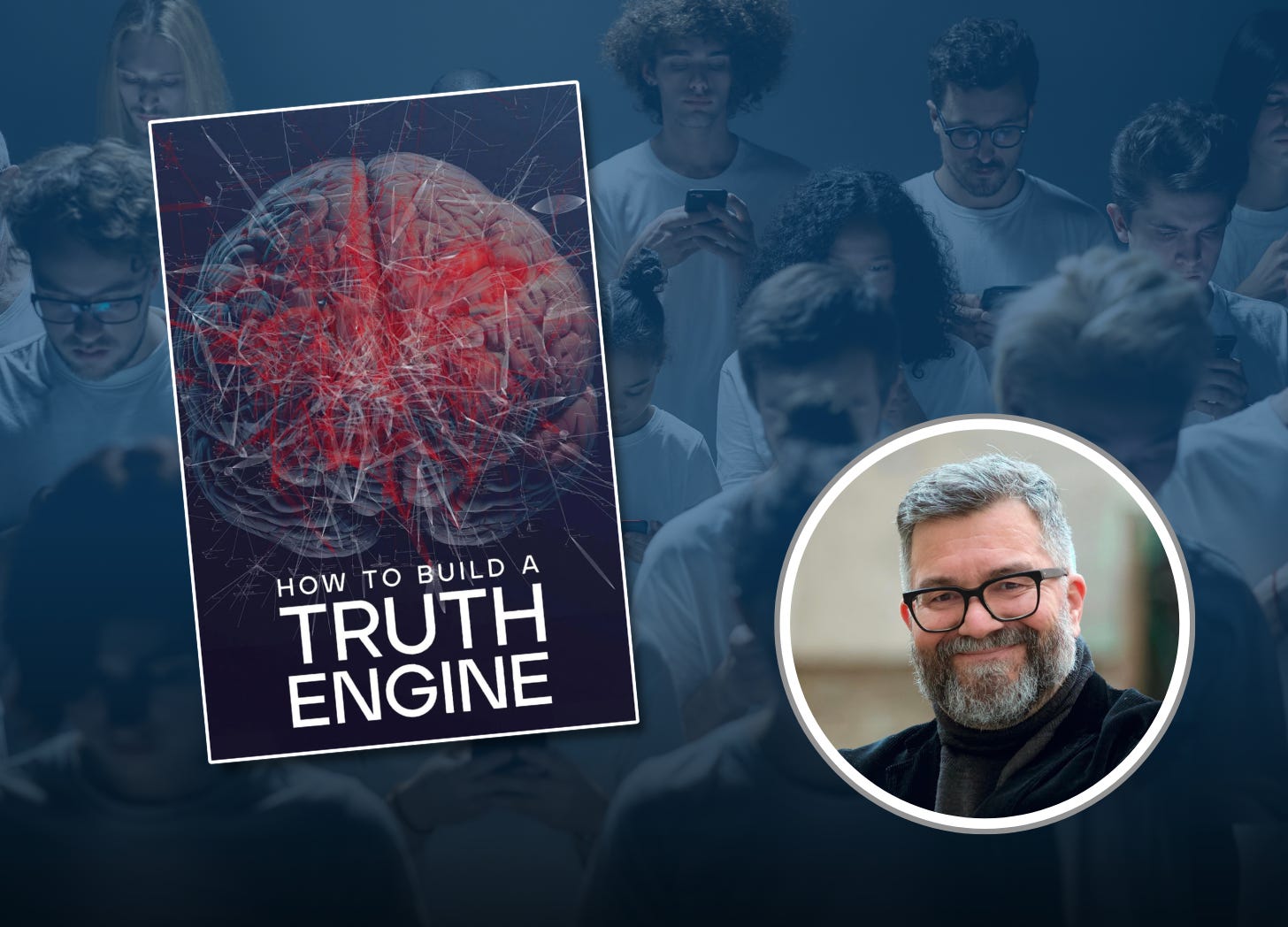
That is why I wanted to speak with Austrian filmmaker Friedrich “Fritz” Moser about his documentary, How to Build a Truth Engine. My colleague Dave Troy introduced me to his work. The film brings together investigative journalism, computer science, and neuroscience to examine our susceptibility to disinformation and what might help us resist it. The film was executive-produced by George Clooney.
Our podcast conversation and livestream explored both the technology spreading information and the human beings trying to make sense of it.
Confusion Can Be Part of the Operation
In our conversations, we discussed psychological operations and the use of information to confuse, disorient, and influence people.
There is documented research on these methods. RAND researchers Christopher Paul and Miriam Matthews describe a Russian propaganda approach they call the “firehose of falsehood”: large volumes of messages distributed rapidly through multiple channels, often without consistency or regard for accuracy. Their analysis examines how this can overwhelm competing information and undermine truthful reporting.
This research provides context for a question Fritz and I explored: What happens when people no longer know how to decide what is trustworthy?
My BITE Model of Authoritarian Control™ examines behavior, information, thought, and emotional control. Under information control, I list three forms of deception: outright lies, withholding essential facts, distorting information, as well as discouraging access to independent sources. See my model for the more complete list.
These are patterns to investigate. Identifying who organized a particular campaign requires evidence; a misleading post alone does not establish its origin or purpose.
From Fact-Checking to Understanding Belief
Fritz initially set out to make a film about automating fact-checking. Could technology help investigators keep pace with the material circulating online?
His work eventually brought him to Prof. Vwani Roychowdhury of UCLA and Prof. Tim Tangherlini of UC Berkeley and their research group, developing StoryMiner, a system for analyzing narratives and the relationships within them. In the film, visualizations help make complicated connections among claims, people, and events easier to examine.
The researchers also encouraged him to speak with neuroscientists. Finding errors in a story and understanding a person’s attachment to that story are different tasks.
That distinction matters in my work. Someone may have built friendships, a sense of purpose, and part of their identity around a belief system. Presenting contradictory evidence can be important, but we also need to understand what reconsidering would mean for that person.
Fritz’s original technology question grew into a much broader inquiry: Why are we susceptible to disinformation, and how can we become better equipped to evaluate it?
Our Minds Learn from What Reaches Them
The film features neuroscientist and neurosurgeon Dr. Itzhak Fried. His team’s work includes recording individual neurons while epilepsy patients undergo cognitive tests to map the brain regions where their seizures occur. In one study of memory formation, patients learned connections between pictures of people and places while researchers observed changes in neuronal responses.
I was fascinated by the opportunity to see learning examined at that level. These findings concern how associations form; explaining coercive influence also requires attention to relationships, context, emotion, and behavior.
Fritz described how we construct a model of the world from the information and experiences available to us. When the range of information narrows, opportunities to test that model can narrow too.
An online community may repeatedly circulate the same claims while dismissing outside sources. Seeing a claim in many places can feel like confirmation, even when those places are repeating one another.
This is why I emphasize consulting unrelated sources. Ten accounts sharing the same original assertion do not provide ten independent pieces of evidence.
Look at the Recruitment Process
We discussed how conspiracy communities can offer participation and belonging. Fritz described QAnon’s puzzle-like structure, with people interpreting clues and helping construct an unfolding narrative. Indeed, QAnon was a Russian psyop using alternate reality gaming technology, according to technologist Jim Stewartson.
When someone participates in producing an explanation, they may become invested in defending it. Reconsidering can also threaten relationships within the group.
I emphasized the importance of examining the surrounding influences. Social psychology’s fundamental attribution error describes a tendency to overemphasize personal characteristics while underestimating situational factors when explaining other people’s behavior.
Calling someone gullible does not tell us how they were approached, what they were told, or what happened when they asked questions.
We need to ask: Who recruited them? What information was withheld? What encouraged continued participation? Were doubts welcomed or punished?
My own experience informs these questions, but so do decades of research and clinical work. Understanding the process gives us more to work with than judging the person.
Trustworthy Journalism Uses Methods We Can Examine
Fritz’s film follows investigative journalists, including members of The New York Times Visual Investigations team. He shows the detailed work involved in checking accounts and assembling evidence about events.
During our livestream, he emphasized standards over labels. An established outlet can make mistakes. An independent journalist or podcaster can produce valuable reporting by following rigorous methods.
Can we identify the sources? Does the evidence support the conclusion? Is opinion distinguished from reporting? Are corrections made openly?
Those questions apply to me as well. If someone tells me I have a date or a fact wrong, I want to see the source and check it. Being willing to correct an error is part of being trustworthy.
The same principle should guide how we evaluate information we agree with. Agreement is not verification.
Build a Trust Pod and Practice Asking Questions
In our livestream, I recommended developing a trust pod: trusted friends or family members with different perspectives who can help you examine a claim, invitation, or opportunity.
You can bring them something and ask, “What do you think? What might I be missing?” The relationship should allow disagreement without humiliation.
I also encourage people to notice their reactions while consuming information. Before sharing something frightening or infuriating, pause.
What is the claim?
Where did it originate?
What would help me establish whether it is accurate?
An emotional reaction can alert us to something important. It cannot establish whether a claim is true.
We also discussed spending time away from our screens. I talked about putting my phone away while eating and socializing. Conversations, time outdoors, and ordinary activities provide experiences beyond those selected by an online feed.
Education That People Can Put into Practice
Fritz has helped establish Open Circle Lab, an initiative developing technology literacy education. He described an experiential approach developed by his colleague Samantha Tady, using games, role-playing, puzzles, and “true crime” investigations.
Participants learn by examining material, making decisions, and discussing what they discover. Fritz reported encouraging feedback from an initial workshop, while the program continues to develop.
This connects with my conversation with Sander van der Linden about Foolproof: Why Misinformation Infects Our Minds and How to Build Immunity. We discussed teaching people to recognize manipulation techniques before encountering them in everyday life.
I would like to see more opportunities for children and adults to practice these skills: checking sources, recognizing pressure, seeking help, and changing their minds without shame.
The Truth Engine Includes Us
When audiences ask Fritz whether there is a truth engine, his answer returns to human responsibility:
“The truth engine, the real and only truth engine, is all of us.”
Technology can help organize evidence. Journalism can uncover information. Education can strengthen our ability to evaluate it. Each still depends on people willing to ask questions and examine their conclusions.
Across my work, I have seen people reconsider beliefs they once regarded as unquestionable. That possibility continues to motivate me. Understanding influence can help us recognize what has happened and make more informed choices.
I encourage you to watch How to Build a Truth Engine or explore hosting a screening, then discuss it with people you trust. Ask what surprised them, what they questioned, and what they would like to understand better.
Those conversations give us opportunities to learn from one another—and to practice the freedom of mind we want to protect.
Further Reading
Rewired: Protecting Your Brain in the Digital Age — with Carl D. Marci, M.D.
Online Radicalization — with Data Scientist Dr. Stuart Shulman
Navigating Journalistic Integrity in an Age of Misinformation — with Anthony Davis
Neural Surfing: Consciousness and Meditation — with David Christopher Lane, PhD