
Inside Australia's Landmark Cult Inquiry Report
Survivors and contributors Lara Kaput and Maria Esguerra unpack the report
Two survivors of authoritarian mind control cults joined me on a livestream last week, and both told me they needed days to recover from the impact of the report before they could talk about it on camera.
Psychologist Maria Esguerra, raised in the Children of God, said she went out and hiked for hours, crying, after she first read it.
Jehovah’s Witness whistleblower Lara Kaput said much the same. They had each finished reading a report that named, in exhaustive detail, almost everything they had spent years trying to get someone in power to acknowledge.
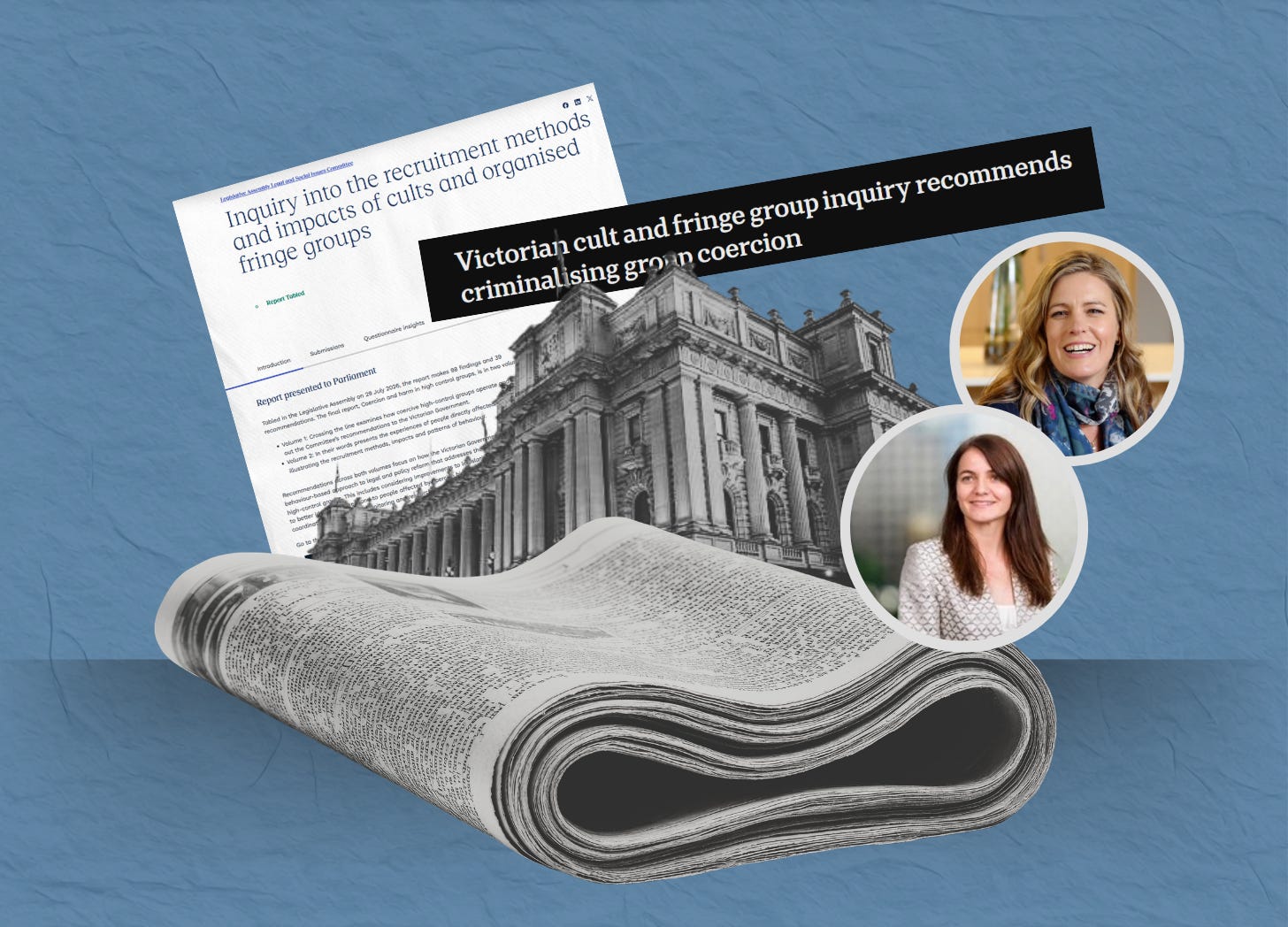
On August 7, 2026, Maria and Lara joined me to break down a landmark two-volume report from the Parliament of Victoria, Australia. The reports are called Crossing the Line and In Their Words, and they are the product of a parliamentary Inquiry into the Recruitment Methods and Impacts of Cults and Organised Fringe Groups.
The Committee’s own term for what it studied is coercive high-control groups, believing the word cult is too problematic for use in the law.
The Committee reached 98 findings and issued 39 recommendations, built on 48 individual parliamentary submissions alone made by persons impacted by Jehovah’s Witnesses, plus testimony, an anonymous survey, and roughly a year and a half of evidence gathering.
Lara told me the report echoes about three-quarters of what she has spent a decade asking Australian officials to address.
The Two Women Who Lived What This Report Describes
Lara is a former Jehovah’s Witness who spent nineteen years inside the organization in Victoria before leaving. Over the past decade she has become one of the most persistent voices exposing what she calls eight forms of modern slavery inside the Watchtower Society, including forced marriage, human trafficking, and labor exploitation.
She was once very deeply involved with a Salvation Army-led Lived Experience Participation Program (LEEP) that focused on modern slavery. I had previously interviewed Lara for my podcast Cults, Culture & Coercion, where she laid out the eight forms of modern-day cult slavery, linked below if this is your first time hearing her name.
Maria grew up inside the Children of God, a group notorious for the sexual exploitation of children. She has told me before how much of her childhood was shaped by illness the group refused to treat as medical rather than spiritual.
“I had measles, chicken pox, mumps, malaria, every imaginable childhood disease, lots of parasites,” she said in an earlier conversation we had.
Her father died of Hodgkin’s Lymphoma, a largely curable cancer, when she was four, because the group treated illness as a sign of God’s judgment rather than a reason to see a doctor.
She left the group at 22 with two young children, one of whom had recently survived a coma caused by meningitis, and rebuilt her life door to door, selling cookies and working call centers before her first day of formal schooling, at 28 — university.
Maria is now a registered psychologist, managing other psychologists in a practice she retired from as Director of Assessable, an organization serving people with disabilities. Maria is co-director of the Olive Leaf Network, a nonprofit serving survivors of coercive high-control groups in Australia.
Both women made submissions to the Victorian inquiry, and Maria gave witness testimony directly to the Committee. Lara said she counted 60 references to her own evidence across the two volumes, and that Maria had told her, before our conversation, that her own count was close to 100.
“It is incredible to see all the findings and recommendations, how they match up so beautifully to the things that we said as survivors,” Maria told me. “Word for word, some of them, the findings.”
Coercive high-control groups are the throughline of everything this inquiry investigated, and Lara and Maria are two of the people who lived it, named it, and spent years trying to get a government to write it down.
Criminalizing Group-Based Coercion
The recommendation Lara returned to again, and again is Recommendation 2, which directs the Victorian Law Reform Commission to review legislative options to criminalise group-based coercion, with a report due by July 2028. Recommendation 3 goes a step further, committing the government to introducing that legislation by February 2029.
“So, this is the first of its type in the world,” Lara noted.
The proposed offense would require proof of a sustained pattern of coercive conduct rather than a single act, and it states plainly that apparent consent or compliance is not a defense where that consent was produced by the coercive conditions the offense is designed to address.
One detail in particular stopped Lara cold. The Commission is directed to examine how the new offense would interact with Victoria’s existing family violence, human trafficking, elder abuse, and labor exploitation laws, and to identify where those laws fall short. “That really knocked me out,” she said.
Not every detail sat well with her. The recommendation asks that any offense be “behaviour-focused and belief-neutral,” meaning prosecutors would never need to prove a group is a cult or that its beliefs are inherently harmful, only that the conduct itself was coercive.
Pushing back on that framing, Lara noted that “I thought it should be crime focused,” she said, arguing that conduct itself, not a philosophical argument over belief systems, should be the measure a court applies.
Maria’s read on the same recommendation was less about drafting and more about recognition. For a group like the Children of God, the harm was never confined to one bad actor. It was built into how the group functioned day to day, which is exactly what a pattern-of-conduct offense is designed to capture.
Protecting Children Inside Coercive High-Control Groups
A cluster of recommendations addresses exactly the kind of situation both women have spent years documenting. Recommendation 5 asks the government to review whether Victoria’s mandatory reporting scheme adequately covers groups that avoid the legal markers of a formal organization, citing informal congregational structures, such as the “Two-by-Twos” (also called “The Truth” or “The Church with No Name”), as an example of a group that can fall outside a scheme built around institutions with a clear legal identity.
Recommendation 6 goes further, requiring organizations to pre-nominate a backup contact authorized to handle abuse allegations if the head of the organization is the one accused. Lara told me this recommendation describes her peer’s own case directly.
“We reported the most senior Jehovah’s Witness to the scheme, and there was no one to speak,” she said, still visibly moved describing it days later. “I was nearly crying just re-reading this today.”
Maria’s contribution here came from the other end of the same problem in that these groups have adults trusted with total, unsupervised authority over children. She had recently appeared in the Australian media discussing the Redeemer Baptist School, and she and the Olive Leaf Network were preparing to fly to Victoria for a related inquiry hearing the following Monday.
“They have full functional control,” she said of the adults running that school. “They’re all volunteers. It’s quite concerning the amount of control they have of these children ....”
She connected that to corporal punishment, a practice she said child psychiatrists have linked to lasting brain trauma, and to Recommendation 12, which asks Victoria to reconsider its definition of “child-related work” so that adults who exercise sustained, functional control over children in informal group settings, not only formal caregiving roles, fall within existing screening requirements.
Recommendation 4 asks the government to review home schooling arrangements for the same reason, so isolated children gain more points of contact with people outside their group. Together, these recommendations target the same vulnerability — children whose only trusted adults are inside the group that controls them.
Training the Adults Who Are Supposed to Notice
The report also recommends updating PROTECT, the guidance Victorian schools used to train mandatory reporters, to include specific indicators for children affected by coercive high-control groups, and it recommends that universities receive coordinated awareness materials about deceptive recruitment on campus.
Lara connected the university recommendation to a group she called Shincheonji, which she said actively recruits on Australian campuses the same way it operates internationally. She also described a professional development tool a colleague of Maria’s, physician Caroline Ansley, built for general practitioners across New Zealand, walking doctors through what coercive control in a high-demand group looks like in an exam room and how to route a patient toward support.
“We get pushed as health practitioners to respect people’s cultures,” Maria said, “but if a woman comes in with bruises and says everything is great, we don’t just take that at face value.”
Recommendation 31 was the one Lara singled out as her personal favorite. It asks Victoria Police to build a clear internal pathway, staffed by officers with specialist expertise, for handling matters involving coercive high-control groups, whether through a dedicated unit, specialist capacity inside an existing unit, or a designated liaison role.
“My dedicated liaison function preference would be a cult watch agency that was independent of the government,” Lara said. “This is the best recommendation for me.”
Maria was more cautious about police as an institution generally. “The law is like a blunt instrument,” she said, noting that many survivors were raised to fear police and that most of her own reports to law enforcement through the Olive Leaf Network go nowhere. What she wants alongside any new police pathway is lived experience sitting in the room.
“It’s like a cultural competency,” she said. “Otherwise, it just looks too bizarre to them, or they might even think people are lying, because it seems so crazy.”
What Happens to a Recommendation?
None of this is law yet. A parliamentary committee’s findings go to the Victorian Government, which has six months to respond in writing to each recommendation as supported, supported in principle, or not supported.
“It never means that activism is over,” Lara said. “It never means that our work is done.”
She is urging Australians to contact their Minister of Parliament (MP) representative before that window closes, since well-funded groups will be lobbying quietly in the opposite direction. Lara also flagged something horrific that happened after the report’s release, namely a privacy breach exposed submitters’ information, including her own, to cult apologists and church leaders.
Because she and Maria are already public advocates, she said, they were perhaps not as affected than many of the hundreds of people who trusted the process (172 were “name withheld” or “confidential”) with their stories; though Lara said she had vomited when she realised her personal contact details were shared.
Maria and I have talked before about how survivors who choose to speak publicly function like white blood cells for the rest of society, identifying and responding to a harm most people cannot see until it is named for them. Listening to her and Lara move through this report recommendation by recommendation, that is exactly what I watched happen.
“It was our day in court,” Maria told me, “because we’ve never really had any acknowledgment.” She was blunt about what happens if the acknowledgment stops there. “If nothing comes of it, I think it will be quite devastating.”
What struck me most is how much of this report reads back what I have argued for fifty years in that people rarely fall into coercive high-control groups through one bad decision. They are moved in gradually, through relationships they already trusted, until the group controls what they are allowed to question and who they are permitted to leave.
The Committee’s own findings describe recruitment as “not a single moment but a gradual, deliberate process.” Lara and Maria lived that process as children, inside groups that could not be more different on the surface and nearly identical underneath. Now they have a government document that says, in writing, that it happened, and 39 recommendations aimed at protecting children, young people, and vulnerable adults.
Watch the full livestream with Maria and Lara. And if you live outside Victoria, ask yourself what a report like this one would find if someone finally wrote it about your own country.
Further Reading
What’s Wrong with the Jehovah’s Witnesses: A Conversation with Whistleblower Lara Kaput: Lara’s first appearance on the podcast, laying out the eight forms of modern slavery she has spent a decade documenting inside the Watchtower Society.
Navigating Life Beyond the Children of God: Maria Esguerra’s own story of growing up in the Children of God and building a new life, including the path that led her to found the Olive Leaf Network.
Born Into A Cult: How Maria Escaped the Children of God Dr. Steven Hassan welcomes Maria Esguerra, a psychologist and survivor of the infamous Children of God cult, to this podcast episode.
Using the Law to Criminalize Cult Leaders: Law professor Robin Boyle on using human trafficking and coercive control statutes to hold cult leaders legally accountable, the same legal terrain Victoria’s new offense is attempting to chart.
Malice Found by Jury in Montana Watchtower Society Sex Abuse Case: A look at how courts have started holding the Watchtower Society accountable for the same reporting failures the Victorian Committee flagged in Recommendations 5 and 6.
Children Are Harmed by Destructive Cults: Part One: A closer look at how coercive high-control groups affect children specifically, the same population Part 4 of the Victorian report is built around protecting.
Public Hearing for Inquiry into Cults
Inquiry into Cults: AUSTRALIA: Victorian Parliament inquiry into recruitment methods and impacts of cults and organised fringe groups


