


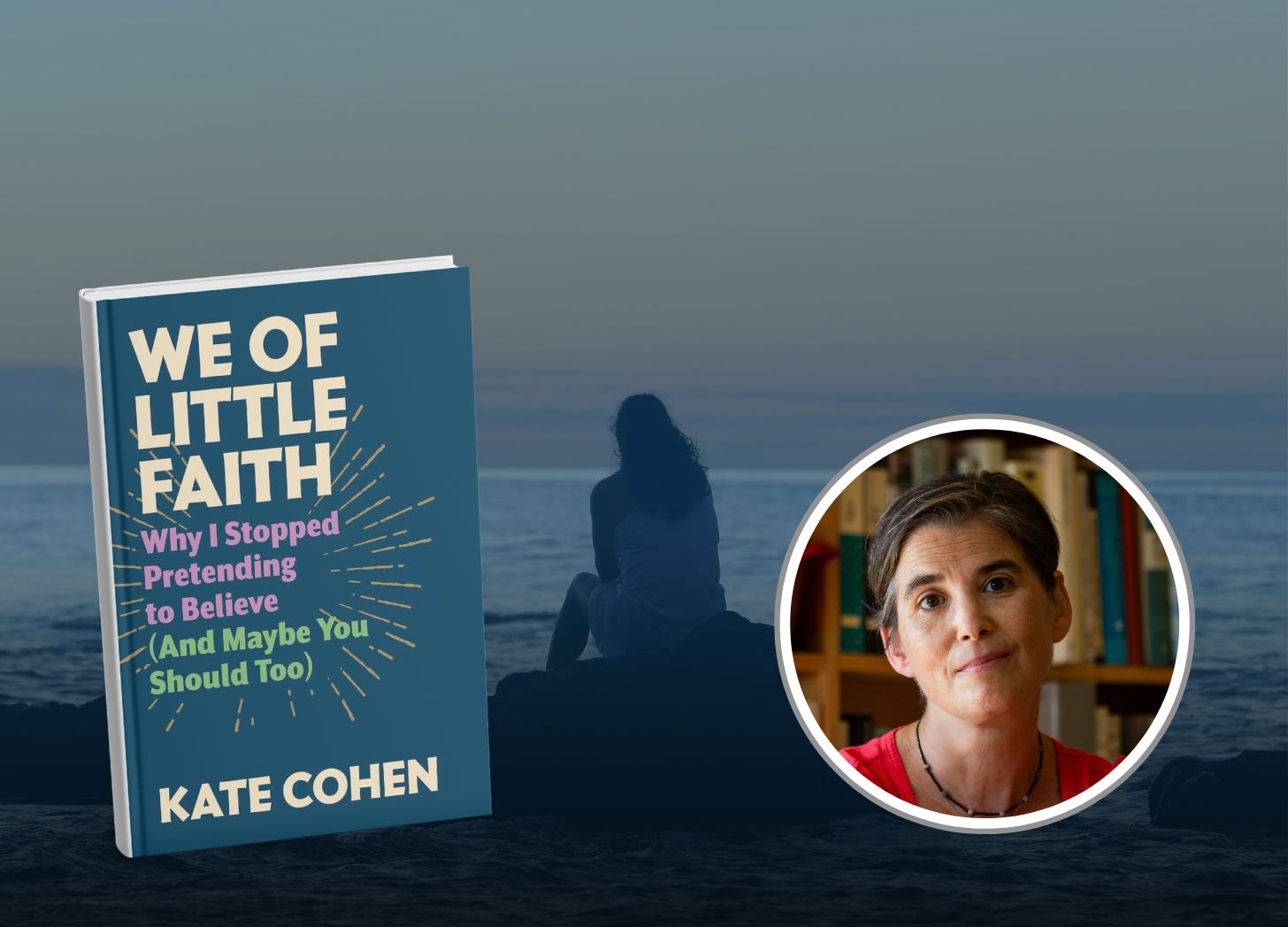
What happens when you tell people what you actually believe? Kate Cohen discovered that the answer can be much less frightening, and much more interesting, than you expect.
For years, she participated in religious life without believing in God. Then she became a mother. Faced with children who trusted her to explain the world, she found she could no longer present something as true when she did not believe it herself.
“I could not tell them something I didn’t believe was true,” she told me. “I just couldn’t do it.”
That commitment to honesty runs through our conversation on Cults, Culture, and Coercion. Kate is a former Washington Post contributing columnist and the author of We of Little Faith: Why I Stopped Pretending to Believe (And Maybe You Should Too). She now writes Scratch on Substack. We talked about raising children, questioning religious authority, defending democracy, and the ordinary acts of creativity that help us remain active participants in our own lives.
We did not agree about every label or every approach to religion. That made the conversation interesting and valuable. Freedom of mind includes the ability to explore different points of view while holding the other person with respect. Too many people today think is simplistic binaries and so if another thinks differently, they might get labeled as “less than” and in the worst case, an enemy.
The permission to be honest
Kate grew up in a Reform Jewish family in a predominantly Christian part of Virginia. Her household was literary and progressive, but she never had a conversation with her parents about whether they actually believed in God. She went along with the prayers and expectations. She assumed she was supposed to.
As she began speaking more openly about her atheism, something changed. People often responded with curiosity. Some shared doubts of their own. A conversation she had feared could become an invitation to greater honesty on both sides.
Her willingness to identify publicly as an atheist is deliberate. She wants to challenge the assumption that atheism tells us whether someone is kind or moral. As she explained, atheists can be generous, selfish, thoughtful, or foolish. For her, humanism describes something more aspirational: the values she wants to live up to.
I appreciated that distinction. An identity does not relieve any of us of the responsibility to examine our behavior. What matters is how we treat people, how we respond to evidence, and whether we can acknowledge when we are wrong.
Where our paths differ
I told Kate that I value identifying as Jewish. I have belonged for the past 26 years to a very progressive Jewish community in Massachusetts, and ritual and prayer have meaning for me. I do not believe in an anthropomorphized God with a beard in the sky sitting with a Book of Life and judging everyone. Most of my community share this perspective although many do not. We value inclusivity and acceptance of one another.
Kate challenged the usefulness of calling that unknown “God.” In her view, people sometimes reach for the word because they have been taught that they ought to believe in something by that name. She also made clear that being an atheist does not erase her own Jewish identity.
We approached awe with different perspectives, too. I described the peace I experience while scuba diving, breathing slowly and looking at fish and a gorgeous reef. For me, that can feel like being in a temple. Kate shares the wonder while seeing no need to attribute it to spiritual forces. We both don’t think there is an anthropomorphized intelligence who is guiding events like sports games or even wars.
We both like and support the Freedom from Religion Foundation which wants to keep a clear separation of church and state. She is most comfortable calling herself an atheist. I am more comfortable calling myself a believer. I felt no judgement from her that there was anything “wrong” with me. We both want people to be able to find community and meaning while retaining the freedom to ask questions, change their minds, and choose their own language for their experience.
What are we teaching children about authority?
One of the most challenging parts of our conversation concerned the Exodus story. After her children were disturbed by the violence in the Passover narrative, Kate returned to the text. She read the story as a demand for fear and obedience to a powerful deity, and questioned the work required to extract the moral lessons she wanted to teach. She had hoped to create a Haggadah (a booklet) version of the seder that emphasized liberation. I still see the story not as historical fact but as a story about leaving bondage of an authoritarian (Pharoah/ cult leader) to eventually find liberation.
I spoke about my appreciation of the Jewish religion for its lack of a central authority and its encouragement to ask questions and decry passages of scripture that are misogynistic, homophobic and violent. Jews do not take the Scripture literally or believer it is inerrant as many fundamentalist Christians do. We know that rabbinic interpretation is continuous over its long history- and the major rabbis disagree often with each other. We also made different choices as parents. I wanted my son to learn Jewish ritual and history, along with the basics of other religions. Kate chose to raise her children as atheists.
I asked what would happen if one of her children decided to become religious. She answered that they now in their 20s. I encouraged her to share my Influence Continuum and BITE model with them to help them orient. Kate was confident that her children would come and talk with her.
Open communication matters. A child should be able to bring a difficult question to a parent without fearing the loss of that relationship. The same principle matters in adult communities. Can you disagree and still belong? Can you say that something feels wrong and be taken seriously? Unfortunately destructive cults often direct people to keep their contact secretive, which is why I encourage inoculation.
When questioning becomes dangerous
Kate’s concern extends beyond any particular religious story. She wants us to examine the habit of allowing an authority figure to decide our moral actions for us. I approach that problem through my work on authoritarian control.
My BITE Model of Authoritarian Control examines behavior, information, thought, and emotional control. Used with my Influence Continuum, it helps people assess how influence operates in a group or relationship. One warning sign we discussed is phobia indoctrination: teaching people that terrible things will happen if they question a leader or leave.
When doubt is treated as evidence of evil, a person can become afraid of their own thinking. If members are also told to avoid critics and former members, they lose opportunities to test what they have been taught. The leader’s claims become harder to examine.
A useful question to ask of any community is what happens when someone challenges its authority. Does the conversation open up? Or do threats, shame, and demands for loyalty take over? I want readers to apply those questions wherever they encounter power, including political movements and secular organizations.
A shared commitment to democracy
Our mutual concern about the rise to power of Christian Nationalism brought these questions into focus. Kate pressed a point that deserves serious consideration: even when she agrees with a religious leader’s moral conclusions, she wants political arguments that people can evaluate without first accepting that leader’s theology.
I emphasized the importance of bringing people together around defending democracy, accountability, and the separation of church and state. People with very different beliefs can cooperate on those commitments. We can value a person’s contribution while continuing to question the reasoning behind it.
For me, that cooperation also requires real conversation. Listen to someone whose perspective differs from yours. Ask how they came to it. Share why you hold your own views. We need opportunities to encounter one another as human beings, beyond the labels and fears that divide us.
Making things and making meaning
Toward the end of our interview, we turned to her Substack called Scratch. Kate writes about the persistent human desire to make things: food, clothing, music, writing, and the rituals through which we give our lives meaning.
She is interested in what happens when convenience separates us from activities we find satisfying. We can eat without cooking, hear music without playing an instrument, and have software generate words we might otherwise have struggled to find ourselves. Her question is what we give up when we stop participating in those processes.
This connected with something I urge people to do: meet your neighbors. Make food together. Play games, make music, and dance. Spend time in your body and in the company of other people. Creativity and connection give us opportunities to exercise our own judgment and discover what matters to us.
Those experiences also help us think about meaning as something we participate in creating. Whether a person finds it in religious community, humanist gatherings, family traditions, or making something with friends, there should be room for personal choice and honest reflection.
Kate and I came to this conversation with different ways of describing belief. We left with a shared concern about surrendering our capacity to think and act for ourselves. You can respect another person, learn from them, and remain responsible for your own conclusions.
Where in your life do you feel free to question? Where do you feel pressure to pretend? I would welcome hearing what has helped you build a community where honesty is possible.
Explore Kate’s writing and the resources below, and share this conversation with someone who would value it. As I often say: it’s your mind, and only you should control it.
Links and further reading
Kate Cohen — author website and book information
Scratch — Kate Cohen on Substack
We of Little Faith — book listing at the Freedom From Religion Foundation
Harvard/ MIT Humanist Chaplain Greg Epstein on his book, Tech Agnostic
BITE Model of Authoritarian Control — Freedom of Mind
Wasn't religion the original social media with the influencer hierarchy
Most Jews don't seem to know what their identity - or even religion - is. It seems malleable. The number of times I've seen them utter 'hey fellow whites' then 'I'm not white I'm Jewish' is astronomical (social media keeps a record of this phenomena practitioners of which seem to lack any self awareness of the incredible hypocrisy therein), and Israeli scholar Israel Shahak goes into some detail regarding the peculiarities of the 'religion' saying it's more a form of polytheism. Ron Unz has a good article. It's certainly not the religion of the Hebrews since from the Roman destruction of the temple in 72AD it's incorporated the Babylonian cult rites, developed the various libraries of Talmud and above all the Cabala, a mystery of which is invoked tirelessly at the 'wailing wall' in what is basically an occult ritual - nothing to do with religion or god. Of course there are different branches of Judaism but rabbinical Judaism is about as far from its roots as Jews are distant from their ancestors since most of them are Eastern European.
So it doesn't matter if Jews are religious or not - they are still Jewish it seems. There might be some compulsion to religion in some families but at least there isn't the penalty for apostasy like in Mohammadanism (which is based nearly entirely on Judaism I eventually realised when studying them).
It's true that knowledge does set you free - but that's ironic as it comes from a religious tradition, all of whose devotees are steeped in ignorance of one kind or another.