


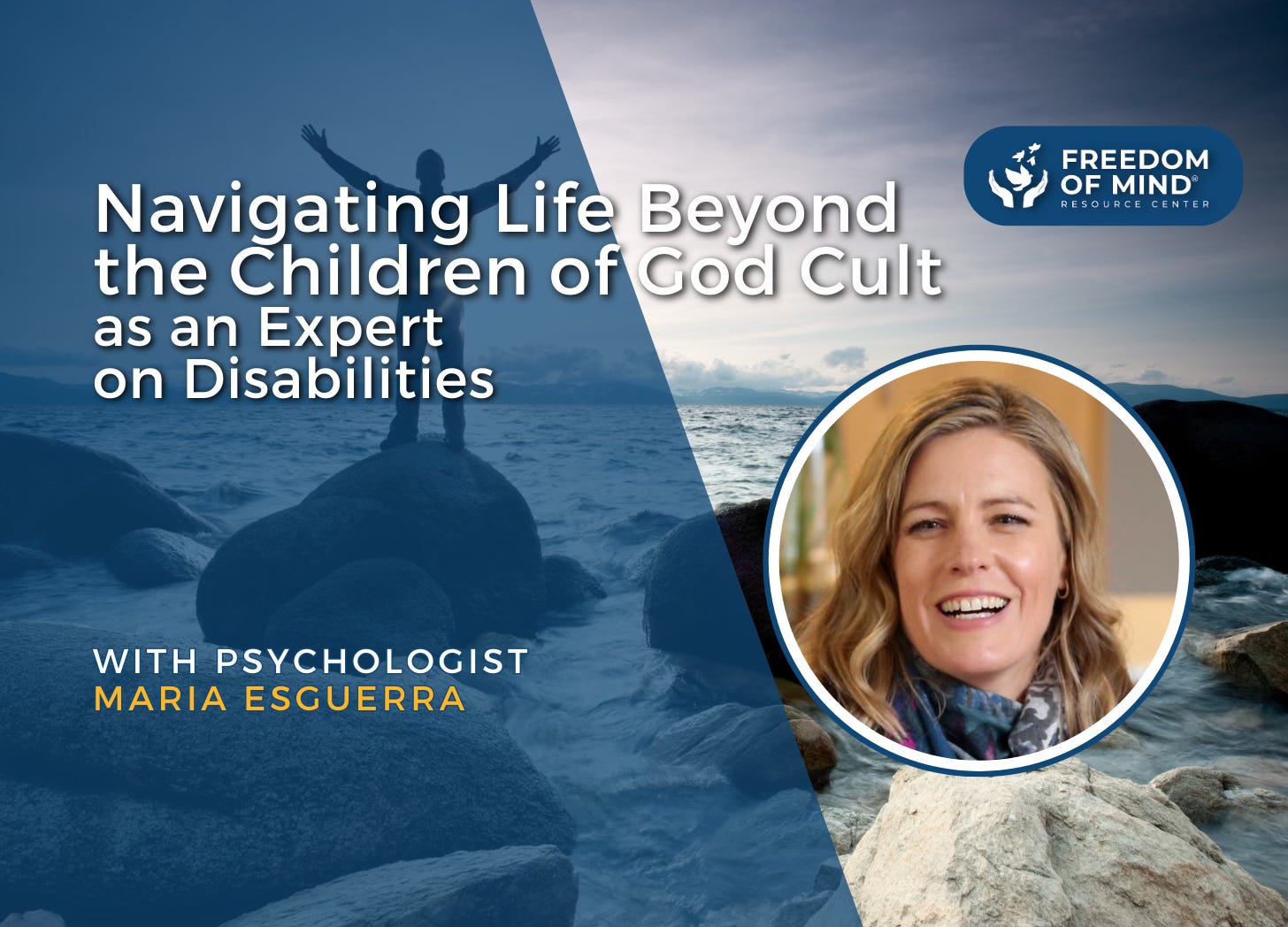
Australian Maria Esguerra tells us that it’s still difficult to speak about her personal experiences as a second-generation survivor of The Children of God cult. “There was a little bit of shame around being a survivor and someone who grew or who’s been in a cultic group,” she said. We then began to discuss what it was like to exit from the cult, to raise two young children, and to build outside support structures at the same time. Despite her discomfort, she felt it important to practice what she preaches when it comes to talking about issues surrounding cults that might seem scary or intimidating.
She later expressed that she understands the vital role sharing stories plays for cult survivors, those contemplating leaving a cult, and individuals who might be targeted by one later. In this episode of The Influence Continuum, we explored the challenges of breaking free from cults and how those who become part of society’s natural defense system against cult indoctrination and authoritarianism help to free others. As Maria and I reflected on our experiences, we emphasized that cult manipulation can affect anyone, yet upon leaving, they become like white blood cells fighting off an infection. With their insider perspective, former cult members can help address and heal these specific issues if they choose to do so.
Childhood Trauma, Illnesses, and Indoctrination
Maria is now a psychologist and Director of Assessable, an organization dedicated to serving people with disabilities. This is an especially commendable achievement in that her early life was shaped by her parent’s involvement in The Children of God cult. Raised under authoritarian control and surrounded by abuse, she was immersed in an environment where members, including children, were exploited to generate profit. Children often participated in performances to make money and were sent to other countries, frequently without even receiving vaccinations. The cult referred to its members as part of a larger “family,” masking the deep dysfunction and exploitation within.
She traced her story back to a childhood of illnesses that mainly went untreated. “I had measles, chicken pox, mumps, malaria, every imaginable childhood disease, lots of parasites,” she said. Her father would eventually die when she was only four years old from Hodgkin Lymphoma, a form of cancer considered to be largely curable. She explained that in The Children of God cult, medical care was avoided as illnesses were considered the fault of the person or as “God judging you.”
Motherhood Within the Children of God Cult
We discussed the experience of raising children within the cult and what ultimately pushed Maria to leave. One of the critical factors in her decision was her son’s battle with meningitis, which left him in a coma at a medical research center for ten days, resulting in a lifelong brain injury. While in Africa, Maria became pregnant again and endured harsh conditions. Upon returning to Australia, she resolved to create a new reality for her children—one rooted in safety and love, something she had not been given.
Second-generation cult members face the problem of having few contacts and connections in the outside world (away from the cult). Being raised in authoritarianism can also lead to a lot of confusion about reality when exiting. Maria said her life became “door to door.” She sold cookies, got call center jobs, raised money, and eventually fought her way to a more stable position within society. Her decision to attend university led to a whole new aspect of her life.
First Day of School and Freedom to Ask Questions
Maria shared that her first day of schooling was when she walked into university. Despite the newness, she found inspiration in familiar subjects, particularly in areas like conformity research and social psychology. We discussed landmark studies, such as Milgram’s experiment, which examined the human tendency to obey authority figures, even when it conflicts with personal morals. In the experiment, participants administered high-voltage shocks to an actor, continuing to do so, even to the point of apparent harm, because they were instructed by an authority figure.
We also talked about the Stanford Prison Study, conducted by Philip Zimbardo, where participants were assigned the roles of either “prisoner” or “guard.” The study showed that even those who identified as pacifists became abusive when given absolute power over others. This study again illustrates that, during those moments, most individuals were willing to follow authority rather than their own values. Maria then remarked that, in her childhood, asking questions and thinking critically were not encouraged, which is why she especially appreciated these lessons during her time in school. She felt overwhelmed with emotion as she began to feel free to question those around her, and how to use her new skills to evaluate research, understand bias and make informed decisions.
Importance of Individual Identity and Social Identity
We discussed the natural human desire for a sense of belonging and connection within groups, which significantly impacts our well-being and self-esteem. Maria's dissertation was on organizational identity, a concept that aligns with Social Identity Theory (SIT), which posits that individuals need meaningful social identification to understand and operate effectively within their environments.
SIT suggests our self-concept comprises both personal identity (unique interests, abilities, and characteristics) and social identity (group affiliations like religion or gender). Within organizations, individuals tend to gravitate toward groups that enhance their self-identity, seeking those perceived as distinctive, prestigious, and engaged in healthy competition with external groups. This "us vs. them" mentality, while sometimes perceived negatively, can be a natural and even positive aspect of maintaining a strong personal and social identity within groups that share our values.
When leaving, ex-cult members lose their sense of personal and social identity. It is important to discover your sense of self by understanding your value system, making meaning and finding your life's mission away from the cult ideology. It is also important to be a part of groups that share these values and can enhance your self-esteem. Ex-members, particularly born and raised survivors, can sometimes be apprehensive about the potential implications of group membership after being harmed. However, understanding and embracing the principles of social identification can foster a positive sense of self.
Training Medical Professionals in Undue Influence and Cults
As we concluded our discussion, we emphasized the importance of training more medical professionals, particularly psychologists, and therapists, to recognize and support individuals who have either left cults or are still involved. I pointed out that cult mind control and specialized treatments are rarely covered in graduate programs. The students might learn about addiction or disabilities, but cults and undue influence were not usually taught. This gap in education was one of the main reasons I created my online course, Understanding Cults: A Foundational Course for Clinicians.
Maria discussed how her current work incorporates shame prevention and the avoidance of punishment-driven approaches in psychology, especially when assisting individuals with profound disabilities. She advocates for a strong emphasis on quality-of-life principles and understanding the unmet needs that lead to undesirable behaviors or relationships. Maria noted that this approach could also apply to cults—by identifying what specific unmet needs a destructive group or leader fulfills in someone’s life. The professional then aims to help the individual discover replacements for those behaviors with “functionally equivalent” alternatives, guiding them toward healthier and more beneficial connections. When this occurs, the overall result is that a person becomes freer to function independently and control their own mind.
Resources:
NDIS psychology services | Assessable | Queensland
Petition: Bring The Family International (aka The Children of God) and Karen Zerby to Justice
Xfamily.org - survivor site for Children of God
Boosting Organisational Identification: A Guide for Managers and Business Owners
Challenging Common Assumptions in Disability Support: talk by Maria Esguerra
Understanding Cults: A Foundational Course for Clinicians (ce-go.com) Steven Hassan