


Since Judge Amy Coney Barrett was nominated to the Supreme Court to fill the seat of the late Justice Ruth Bader Ginsburg, Republicans are seeking to fast-track her confirmation before the end of October. The Trump administration and its Senators are trying to frame some of the opposition to her nomination as religious intolerance. Our concern at Freedom of Mind is not about religious beliefs. It is about authoritarian and abusive practices. In fact, People of Praise has a long history of controversy along with other Covenant communities with similar DNA.
We are asking for a thorough Senate investigation into Judge Barrett because when she was interviewed in 2017, she failed to disclose, as was required, that she and her husband were born and raised and current members of the People of Praise.
What’s more, since her nomination, People of Praise has scrubbed their website of mentions and photos of the Barretts. This pattern of shadowy behavior suggests that they have something to hide. The group’s policies show, and ex-members corroborate, that the People of Praise Community is a high-demand, cult-like authoritarian group. Former members assert that this may influence her judicial abilities. In my view, the behavior they describe fit the BITE model of Authoritarian Control. See below for analysis.
There is more to this involvement than an individual membership in an organization. She is part of a family legacy of involvement with this group and it founders. It has been reported that her husband, grandfather, father, and many of her siblings are also members. This raises serious concerns about her ability to function independently on a variety of issues that may come before the SCOTUS.
People of Praise believes in what they call male headship – which in practice means that male leaders and husbands dominate in all things. What happens if Barrett is told what she should do concerning a legal case? Members sign a lifetime covenant of obedience, so it is reasonable to assume that she has done so. (It might be worth the Committee requesting a copy of her signed covenant). If a case came before her in which the cult leadership, her father, husband and/or siblings had a view and sought to direct her judicial function, would she be capable of judging the case on the merits? The group believes in the practice of shunning members who do not conform to its dictates. We thus have to ask if she would be willing to risk shunning or banishment from POP by rendering/joining in a judicial decision that was contrary to the cult’s values, doctrines and direction?
I told the Associated Press that the culture within the People of Praise creates fear so that people remain obedient and dependent. I said, “A person who is in one of these groups has to suppress their own thoughts, feelings, desires that doesn’t align with the dogma.”
The group employs specific tactics of authoritarian control. I have spoken with former members, researchers, journalists, and attorneys about this organization. Using this information, I have evaluated the People of Praise in terms of the BITE Model of Authoritarian Control. (I am including a link to a video panel discussion with former members, below.)
Members are asked to sign the Covenant, which is a lifetime commitment, without proper informed consent. (For a deeper discussion of informed consent, undue influence, and the People of Praise, please read my previous blog.) The group reportedly requires wives and children to be submissive to their husbands, promotes fear of losing God’s grace and hellfire, allows and encourages corporal punishment of children and wives, engages in exorcisms of “demons,” and, in some cases, encourages shunning former members, and much more. Members are asked to make a lifetime vow, donate lots of money, and follow specific dogmatic rules under fear of consequences such as shunning.
Although the group may be new to some, it has been studied and written about for decades. A Notre Dame professor, Dr. Adrian Reimers, wrote a 2017 book entitled: Not Reliable Guides: an analysis of some covenant community structures about his twelve-year experience which led him to leave the group with his family. In 1997, a Catholic Reporter article detailed the significant problems that exist with these organizations which are being run by people without theological training and certification. Others are sounding the alarm and speaking out like Catholic writer Frank L. Cocozzelli.
And to help formulate appropriate questions to ascertain if the group engages in the kind of authoritarian and abusive practices of a cult, the Senate should consult with people that are experts on cults.
Below is a video discussion with several former members including someone who had been involved for 23 years, Kent Burtner who is a former Dominican priest and a practicing Catholic who has done cult counseling cases with me, journalist and researcher Russell Bellant, Catholic writer Frank L. Cocozzelli that discusses specifics, along with a BITE model analysis of the group, based upon feedback from former members. Decide for yourself, after reviewing, and, if you draw the same conclusion, contact your elected officials, the media and join us in a call for a thorough investigation!
Video Discussion about The People of Praise (10/10/20)
Control of Behavior, Information, Thoughts and Emotions
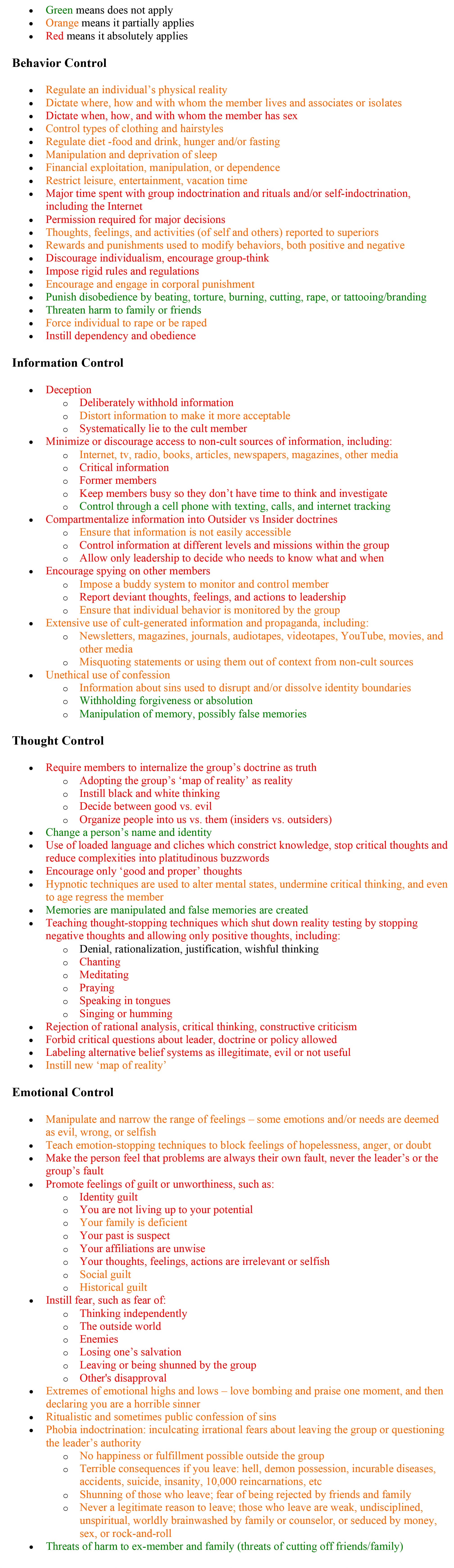
After much research, conversations with journalists, and interviews of former members, I feel there is enough evidence that the People of Praise Community uses specific methods and techniques that influence how a person thinks, feels, and acts to instill obedience over conscience. Below is an analysis of the group using the four-component BITE Model of Authoritarian Control. I developed this model over thirty years ago based on Festinger’s Cognitive Dissonance Theory, and Lifton’s and Singer’s models developed from studying brainwashing in the 1950s. “BITE” stands for Behavior, Information, Thought, and Emotional control.
The BITE Model of Authoritarian Control is a vehicle for understanding the phenomenon of mind control. I use the United Nations Declaration of Human Rights as the basis for my analysis. Many people incorrectly think of mind control as an ambiguous, mystical process that cannot be defined in concrete terms. In reality, mind control refers to a specific set of methods and techniques. Destructive mind control can be determined when the overall effect of these four components promotes dependency and obedience to some leader or cause; it is not necessary for every single item on the list to be present. In fact, there only need to be a few major behaviors under each of the four components.
I have color-coded it the following way: [I welcome feedback. Does this analysis fit? Please let me know what you think! (contact us)]
Update: Letter to the Senators on the Judiciary Committee Concerning the Confirmation of Amy Coney Barrett
Featured image credit: Rachel Malehorn, Creative Commons Attribution 4.0
The post People of Praise Covenant Community: BITE Model© of Authoritarian Control Evaluation appeared first on Freedom of Mind Resource Center.