



Technology was developed as a tool to serve humans, not vice versa. Unfortunately, we humans seem to have forgotten this, as billions worldwide are literally addicted to our smartphones. Many in the upper echelon of technology circles propose and even ominously insist upon humanity serving technology futures. They believe that we, the people, should work towards constant innovation, a technological race to the top, even at the cost of humanity’s future. There is also an emerging thoughtform that suggests that humanity should sacrifice the planet, our very means of existence, to ensure that technology AI data personas would be preserved and reach their ultimate destiny.
Suppose this idea sounds profoundly unstable and dystopian. In that case, you might be comforted to know that it sounds equally problematic to many specialists in the fields of mental health and ethics. However, we also see that some tech billionaires and Silicon Valley executives are increasingly willing to doom humanity for a tech-centric future. On this episode of the Influence Continuum, I talked with Greg M. Epstein, author of Tech Agnostic, a work described as “How Technology Became the World’s Most Powerful Religion, and Why It Desperately Needs a Reformation.”
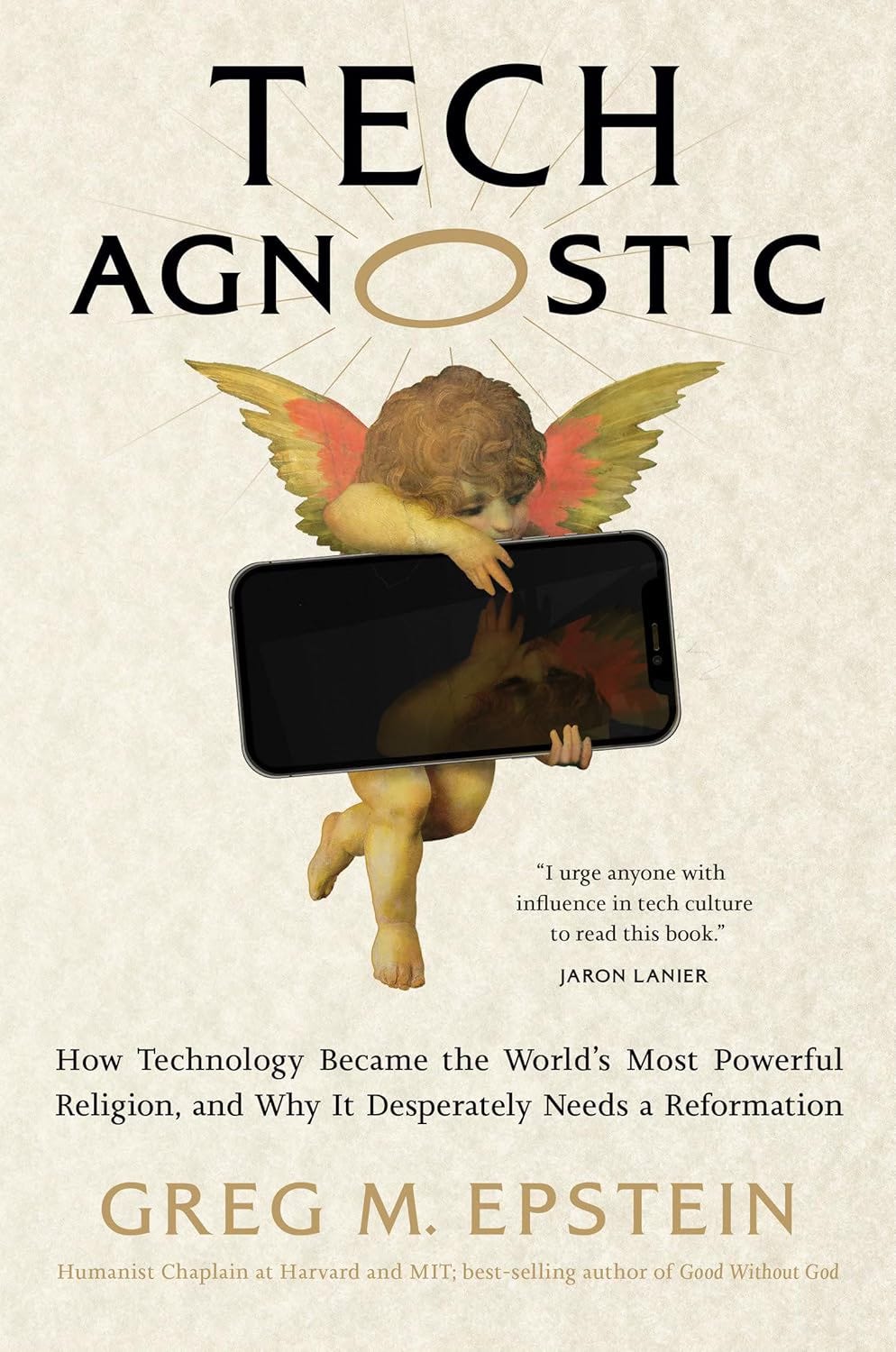
In his book, peer-reviewed through The MIT Press and distributed by Penguin Random House, he asked, “Who is profiting from these tech-centric futures, and how can we center humanity at the heart of engineering?” Greg is also a Humanist chaplain at Harvard and MIT. He wrote the 2010 book Good Without God: What a Billion Nonreligious People Do Believe. The book focuses on the positive beliefs of tolerance, community, morality, and good without relying on a higher being. He is now focused on how technology has become a part of our every interaction with the world and how some technology leaders use the cult playbook to line their pockets further.
Technology as a Religion
“Tech gets quite culty at times,” Greg said at the start of our discussion. He continued, “People would do well to imagine for a moment or to the world of tech today, Silicon Valley Tech, as being like a religion because it would help them to understand what the impact of that whole set of phenomena is on our lives now.” He described how the Influence Continuum and the BITE Model of Authoritarian Control assisted him in further designing and illuminating his theories in the book. To him, some technology organizations mirror large religious groups like the Moonies, with carefully constructed manipulations at the core.
“Having a skeptical mind, asking questions, is the essence of the human experience,” he reminded listeners, and we spoke about how humanity should not be fodder for billionaires who want to fulfill their megalomaniac goals. Some technology leaders directly mirror the stereotypical cult leader profile of malignant narcissism. However, Greg also noted that in addition to the cult model of indoctrination, technological communities have some of the most powerful tools for achieving mind control that civilizations have ever witnessed.
TECH Focus Leading to the Doom of Both Religion and Humanity
The religion of technology is often Apocalyptic in nature, with the idea of the need for it to preserve future civilizations. However, with recent news about energy costs of data centers and potential pollution problems in the rare mineral mining industry, we should consider carefully whether and how technology is the answer we’re looking for on Earth’s most pressing problems, like the Climate Crisis.
Greg described how he entered the idea that technology had become a religion around 2018, as he contemplated how society had begun to interact on social media. “We had really spent a decade, many of us turning over our communal, our social lives to these, you know, tech websites and apps, and I started comparing that to the congregational experience,” he said. After many years of researching this hypothesis, he believes technology has “transcended any one of our world’s major religions.”
“It plays a greater role in our day-to-day lives, community lives, and even the way we think about the world,” he said. He discussed examples, such as Anthony Levandowski, who was pardoned by former President Trump, and his The Way of the Future Church, which focused on AI development and nonbiological life forms. We also discussed the Friend.com necklace, a wearable AI companion that tracks the wearer’s conversation, including those of others around you. The Friend will then make recommendations through an AI chatbot to benefit the user. The founder noted that this creation is meant to replace God and the relationship with God. He finished by listing Technological Singularity, a theory surrounding our proposed meld with machines, creating non-human AI sentient beings.
Describing the Connections and Players
We talked about some players in the technological world who are looking for ethical good, like the Center for Humane Technology, which focuses on today’s challenging technology questions. We also spoke about the Bitcoin and crypto world, how organizations like the Heritage Foundation, the Federalist Society, Project 2025, and what role Elon Musk and his eternal search for a mission to Mars might all play in this side. Unfortunately, we must also mention the roles that Russia and China may play in future technology discussions and motivations.
Positive Outlooks for a Realistic Future
“I want to make a pitch, a plea even for more agnosticism in tech and society,” Greg proposed towards the end of the interview. He noted that the congregation that he served is often comprised of “atheists, agnostics, and allies.” He said that Humanism was about being good and wanting to live in a good world. He hoped that what was in his new book might assist in the conversation.
We remind listeners that there is only one Mother Earth, our planet. This is our world. “If we were on a ship, would we let somebody drill holes into the bottom of the ship?” That’s why I encourage everyone to read Tech Agnostic and examine healthy technology use in their own lives.
Resources:
Featured book: Tech Agnostic by Greg Epstein - MIT Press
Good Without God: What a Billion Nonreligious People Do Believe by Greg Epstein
Greg Epstein | Harvard Chaplains
Center for Humane Technology’s Your Undivided Attention Podcast: What Can We Do About Abusive Chatbots? With Meetali Jain and Camille Carlton released 11/7/24 - (Steven appears around minute 9)
The Digital World, Tech, Social Media, AI, Hypnosis, Psychological Warfare and Undue Influence
Rewired: Protecting Your Brain in the Digital Age with Carl D. Marci, M.D.
How Online Spaces And Communities Are Indoctrinating Gen Z And Gen A With Chloe Combi
A Cure to the Metaverse: Relational Maturity- Aureet Bar-Yam Hassan’s Developmental Theory
Unveiling the Shadows: The Role of Psychological Warfare, Psyops, and Military Recruitment
Online Radicalization with Data Scientist Dr. Stuart Shulman
Beware the Metaverse: Dr. Rand Waltzman discusses Artificial Intelligence, AI, and the Internet