


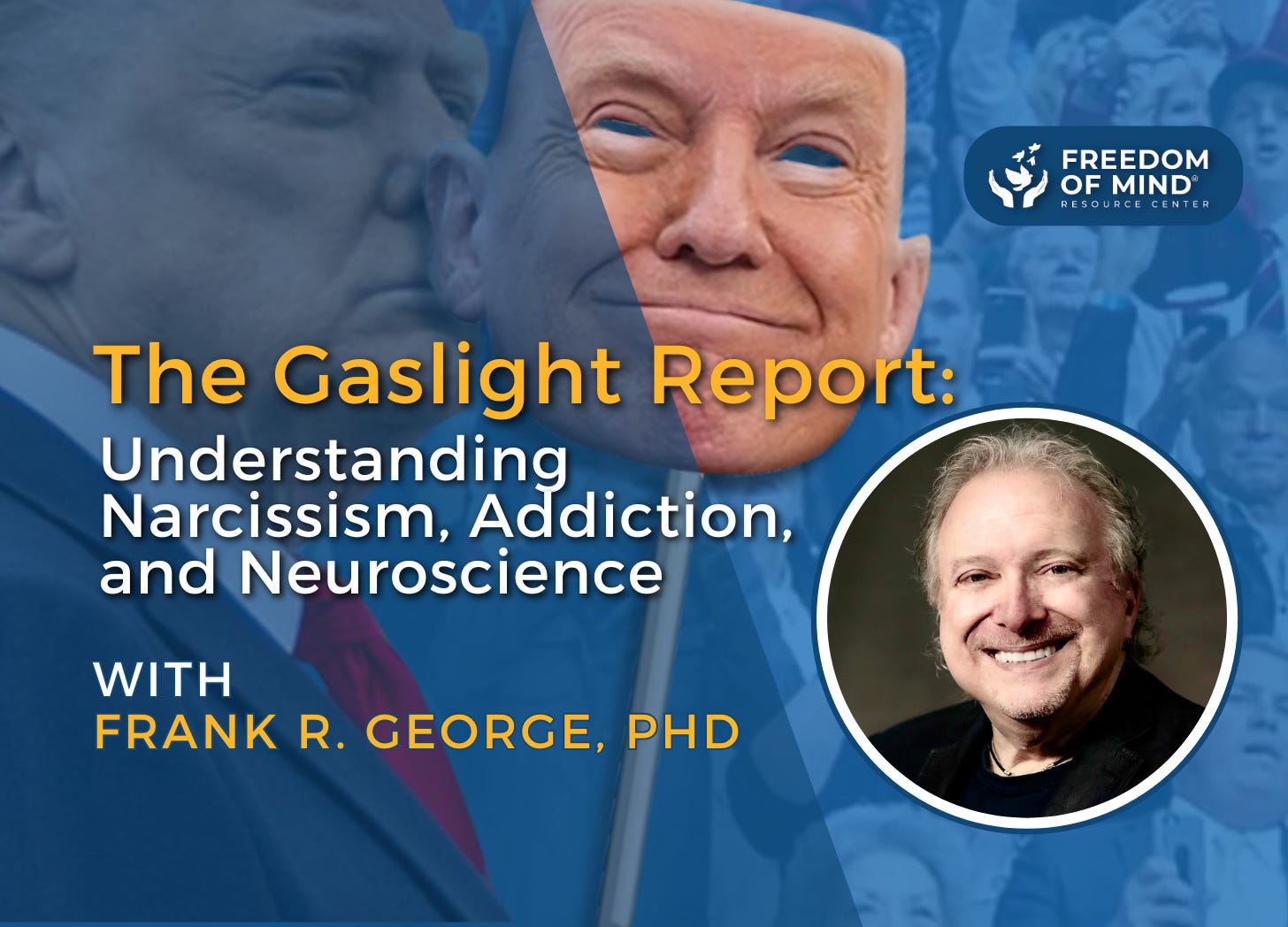
Dr. Frank R. George is an internationally recognized authority in psychology, neuroscience, narcissism, and addiction. Through his Substack newsletter, The Gaslight Report, he demystifies pathological narcissism, explores its underlying causes, and offers practical strategies that readers can apply in their own lives. He earned his PhD in psychology from the University of Colorado. Over many years, his research has spanned neuroanatomy, neurochemistry, and genetics as they relate to the field of addictions.
After several years of working at the National Institute of Health as a Senior Fellow and Chief of Behavioral and Biochemical Genetics, he opted to branch out to his own biotech medical device company. It was there that Dr. George experienced a disagreement with a board member who he believes showed characteristics of pathological narcissism. This incident led the board member to begin a two-year campaign of sabotage against his career and company. In the process, however, Dr. George became interested in the principles of how pathological narcissism shared many characteristics with addictions. He currently ranks among the top 1% of Google Scholars worldwide, with nearly 200 publications and over 30 patents. Additionally, he has received almost 4,000 citations for his work in the scientific literature.
Traits of Addiction Overlapping with Pathological Narcissism
Dr. George explained that there is a growing amount of scientific evidence showing an overlap between symptoms of addiction and traits of narcissism, even to the extent that functional MRI reveals distinct neural activation patterns in individuals with that personality type. Similarly, withdrawal patterns appear when the person does not receive their preferred types of attention. “What do you see when a narcissist is not getting all that supply? They go through what’s called narcissistic rage, narcissistic collapse, and it just overlaps with withdrawal,” he said.
We examined how Trump’s rallies during the COVID-19 pandemic might illustrate the link between pathological narcissism and risky behavior. Dr. George suggested that, for individuals with pathological narcissism, public attention functions like a drug, a “narcissistic supply” they feel compelled to obtain. When the pandemic forced most activities to shut down, Trump appeared unable to tolerate the loss of that supply. Consequently, he resumed large-scale rallies despite the health risks. Dr. George explained, “After a period of time, he couldn’t take it anymore. He had to get out and get his drug from a crowd. So he went out to do rallies. Does he care if 50,000 people get Covid? No, he doesn’t care at all. He’s a pathological narcissist. He needed his drug.”
Duty to Warn: When the Narcissist’s Mask Starts to Slip
I explained that my understanding and research into narcissism showed personality disorders rooted in insecure or disorganized attachment, and I asked Frank more about his expertise on the condition. He confirmed my thoughts and explained, “Nothing they do is authentic. There is no authenticity. It’s all transactional. And underneath that mask is this pathological insecurity.” He warned, “Their total reason for existing is to preserve their mask.” Therefore, when that mask starts to fall, as in the case of the Epstein files, they will do anything to preserve it.
We discussed how the American Psychiatric Association’s (APA) Goldwater Rule, in our view, an outdated policy, has blocked qualified experts from speaking publicly about the issue. Dr. George observed that this “dampening effect” has undermined the entire effort, since psychiatrists were effectively silenced from the outset of Trump’s first administration. He previously led the Colorado chapter of Duty to Warn, an organization comprising tens of thousands of mental health professionals whose mission is to alert the public that Donald Trump is unfit for office. He now advises individuals to contact the APA and express their concerns about how the rule dissuades experts from providing appropriate guidance.
Contagion Effects of Pathological Narcissism
I recalled that when I was in the Moonies, the higher I got up in the group, the more I wanted to be bowed down to, as we bowed to Sun Myung Moon, who was a malignant narcissist. I asked Frank to discuss further this “contagion effect” that can occur in neuroscience. He referenced Trump’s cabinet members and how they are transforming over time. “They’re all becoming little Trumps in that sense, right?” he noted.
We talked about former President Reagan’s “trickle-down economics,” in which wealth was supposed to be shared throughout society. However, as Dr. George noted, while wealth was not distributed as proposed, it appears that ideas of evil (as referenced by thinkers such as Kant, Arendt, and Freud) do spread to those working closely alongside a pathological narcissistic leader. What he calls “evilnomics.” In that way, he stated, narcissism does spread like a contagion.
Social Media Addiction and Helping Ourselves
We examined the impact of social media on psychological functioning, focusing on how excessive screen time may alter brain health by inducing repeated dopamine spikes through intermittent reinforcement. Dr. George outlined a standard set of screening questions clinicians can use to assess possible socialmedia use disorder, such as the frequency of non-purposeful texting, the number of self-photos taken for posting, and the total daily time spent on computers or smartphones. While we concurred that the internet is an invaluable tool for business, education, and long-distance communication, we also emphasized that platform algorithms are deliberately designed to maximize user engagement. Additionally, external actors can manipulate users’ thoughts and attitudes. We highlighted the importance of preserving face-to-facehuman interaction as a counterbalance to digital immersion.
I recommend listeners check out Dr. George’s Substack, The Gaslight Report, where they can find further strategies to filter misinformation and focus on solutions-driven information on pathological narcissism and more.
Resources:
The Gaslight Report by Frank George, PhD
Selected articles from The Gaslight Report:
A Synergy of Madness: Why Trump is Declining on the World Stage
Narcissism, Dementia, and Trump’s Rotting Brain
George, F.R. and Short, D. The Cognitive Neuroscience of Narcissism. Journal of Brain, Behavior and Cognitive Sciences, 1:5-9, 2018
George, F.R. Genetic models in the study of alcoholism and substance abuse mechanisms. Progress in Neuropsychopharmacology and Biological Psychiatry, 17:345-361, 1993.
George, F.R. Addiction and Pathological Narcissism: Narcissistic Supply as a Drug and Narcissists as a Reinforcer. Advances in Clinical Psychology, 4:106, 2024
Just saw your interview with Steven Hassan and it was so informative! We need to hear more 👍
This was one of your best presentations. Dr. George is a stellar expert. As a practicing attorney, writer, and member of the US Supreme Court Bar, let me point out two problems: First, law and psychiatry/psychology do not "play well" together. Defending many clients including murderers, abusers, etc., I have had to present psychological defenses or explanations in court. But the state by state variations of interpretations of the M'Naghten Rule (was the event caused by a mental disease or defect) make it exceedingly difficult to marry the two. In one case, had my client murdered her parents in NY she would have gotten off, whereas if she had murdered them in NJ, she would have served a life sentence. Second, the Supreme Court has been my area of expertise for decades. Sadly, the six members of the pro-Trump majority are corrupt and unwilling to properly apply precedent. Coney Barrett is a true member of a cult that places her under the direction of her husband. Thomas is corrupt, on the take from Harlan Crowe, and his wife has been a member of a cult for years. Several belong to Opus Dei. The Heritage Foundation with its Christian Nationalist support has also nurtured many of them over the decades. Do not bother to look for self-assessment or changes among the six, sadly.