


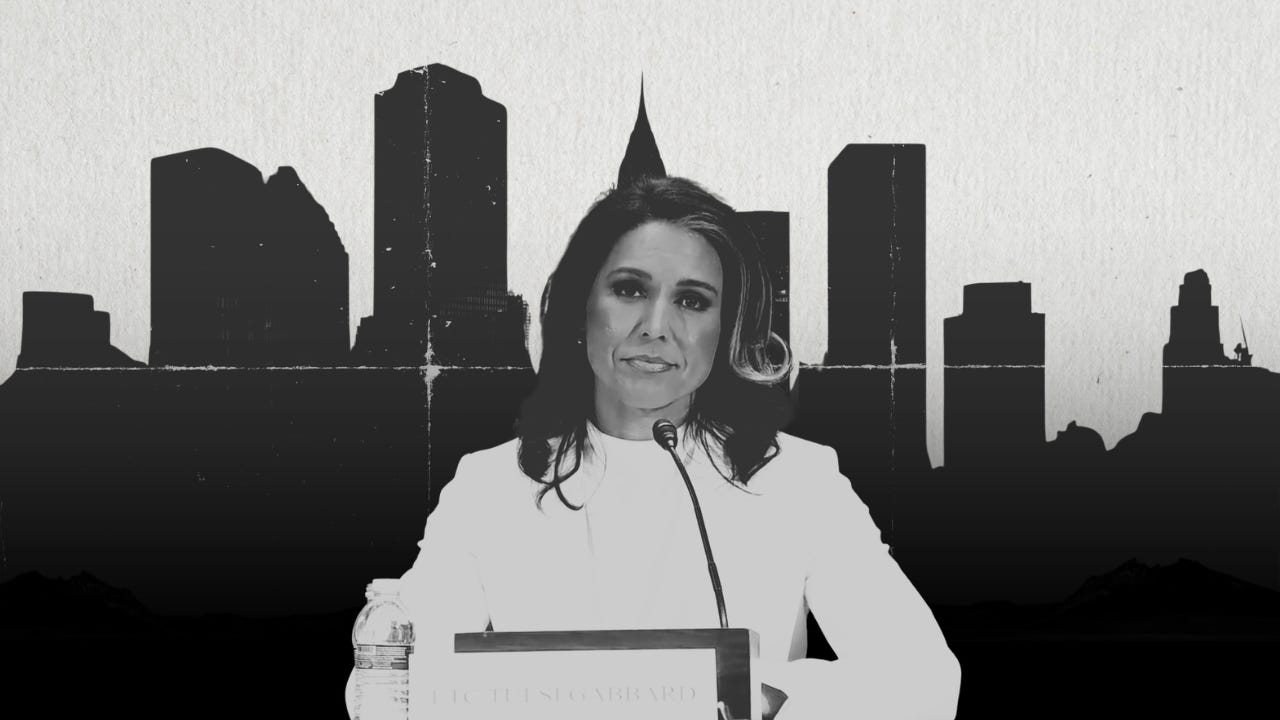
As Director of National Intelligence, Tulsi Gabbard was positioned at the core of the American intelligence network. Her office received sensitive CIA analyses, intercepted communication logs from the NSA, international threat updates, and confidential assessments. This position wields immense influence, guiding national strategy on a grand scale.
Throughout my fifty years of work, I have frequently heard individuals recount the unsettling feeling of executing another person’s directives as their own, and the reality of having their decisions governed by an authoritarian figure or a manipulative organization.
This very dynamic influenced Tulsi Gabbard as someone charged with leading all American intelligence agencies. She operated under mysterious instructions regarding her viewpoints, public statements, and specific responses during adversarial live television interviews.
Following the groundbreaking exposé published by the Washington Post this past June regarding Tulsi Gabbard and her guru, I reached out to the primary whistleblower featured in the report, Rebecca Saltzburg.
Over several weeks I spoke with her at length, had her on my livestream and reviewed some of her original source documents, the same ones behind reporter Jon Swaine’s Washington Post exclusive. She had close, direct access to Gabbard and she is a firsthand witness to much of what she describes. She is also, as you will see, a source with a complicated history.
The Guru
Saltzburg, the Post whistleblower, became involved with the Science of Identity Foundation, the group Gabbard and her family have long followed, in the mid-1990s, and she worked on Tulsi Gabbard’s campaigns until she left in early 2019.
Chris Butler leads the Science of Identity Foundation, a Hawaii-based group presenting itself as part of the Gaudiya Vaishnava, or Hare Krishna, tradition (more on Hare Krishna here). He dropped out of the University of Hawaii in the late 1960s, taught meditation and Krishna devotion, and built a following of people who believed he spoke directly with God. Publicly, the group looks like a yoga and meditation community.
Chris Butler’s following was extremely devoted. In 1970, two of his followers told a Honolulu newspaper reporter they would do anything Butler asked, including kill themselves (Jon Swaine, Washington Post, June 2026). He incorporated the Science of Identity Foundation in 1977 and uses the title Jagad Guru.
Saltzburg and other former members describe an inner circle around Butler, including the Gabbard family, the Bellord family, and Sunil Khemaney, operating in secret behind the public face.
Throughout this period, Saltzburg organized Butler’s private papers, served as one of his confidential secretaries, and spoke with him by phone for hours on ordinary days. Butler tolerated her disagreeing with him, she told me, while rank-and-file members were expected to treat his word, and the word of any group leader, as the word of God.
I use a framework I call the BITE Model of Authoritarian ControlTM, short for Behavior, Information, Thought, and Emotional control, to describe the techniques a group uses to make a person dependent and obedient.
By Saltzburg’s account, and by the Washington Post’s own reporting, Butler’s operation runs on all four. It directed members’ actions, it controlled what they were allowed to know, it forbade independent judgment, and it ran on phobia indoctrination, the practice of instilling irrational fear about leaving or even questioning a group.
Butler himself once described the CIA and other intelligence agencies as staffed by demonic, power-hungry men who wanted to control people with psychic powers, according to a 7,000-page archive of his lectures Washington Post reporter Jon Swaine reviewed. A former associate of Butler’s from the 1970s told the Post his real ambition was simpler: he wanted, in her words, “to rule the world.”
“Get It Done. Don’t Dick Around.”
When Post reporter Jon Swaine first spoke with Rebecca Saltzburg in November 2024, she had told him Gabbard was “a freethinker who took orders from no one” and played down Butler’s group entirely.
Saltzburg later described that she was unsure whether to trust the media to share her story correctly and wanted time to think about whether it was worth the safety risk to come forward. Nine months later, having fallen out with the Science of Identity leadership, she told him a different story and eventually shared more than 25,000 pages of emails and memos.
The documents show hundreds of memos, most from 2011 to 2017, containing what appears to be direction from an unnamed adviser on what legislation Tulsi Gabbard should introduce, what she should say, and how she should carry herself on television.
In one 2014 exchange, the adviser pushed her to propose legislation penalizing Americans who fought for the Islamic State.
“Get it started in the morning... Don’t dick around.” Gabbard issued a statement the next day and introduced a bill a week later.
On veterans’ health care the same year, the mystery adviser argued veterans should get outside care without needing government preapproval first.
“Actually put forward legislation. Get it done.” Gabbard’s op-ed three weeks later left out the preapproval detail, with a later email noting the unnamed adviser was “pissed she didn’t say” it. A month later, Gabbard introduced a bill including the exact detail.
Ahead of a 2015 CNN appearance, a memo instructed her to respond to being excluded from a presidential debate by saying it was not “a ‘boohoo, I don’t get to go to the party’ situation.” On air, she said nearly the same words.
Washington Post journalist Jon Swaine and a colleague compared Gabbard’s remarks in 32 television interviews between 2014 and 2016 against the talking-point memos prepared for them. In 24 of those appearances, she used the memo language almost verbatim. In the other eight, she used different words for the same ideas. Some of the limited remarks attributed to Gabbard herself in the transcripts read like agreement rather than resistance.
“That’s perfect, that line right there,” one says.
The memos to Tulsi Gabbard rarely name their author. When Jon Swaine asked Sunil Khemaney (one of the individuals high up in SIF) about them, Khemaney said he, not Butler, wrote most of the political material, along with Gabbard’s father, adding “one or two” memos touching on religion possibly came from Butler. He offered no way to verify which memos were whose and did not answer follow-up questions asking him to specify.
However, several details contained in the memos to Tulsi Gabbard point toward Butler instead. One memo, buried in a 173-page policy dossier, reminisced about working as a teenager in Hawaii, where Butler grew up. Khemaney nor Mike Gabbard did.
In 19 memos the unnamed adviser appears to identify himself as Butler directly, mostly on questions of faith.
Team members occasionally referred to requests from “S,” while Khemaney is known within the group as “Syd.” One internal memo is addressed from Syd to S, possibly indicating they are different people.
Jon Swaine also asked the AI system Claude to run a stylometric analysis, comparing the unnamed adviser’s language against Butler’s own lecture archive and against Khemaney’s and Mike Gabbard’s writing.
Claude found the material most likely came from a single speaker resembling Butler more closely than the other two, based on shared nonstandard word choices. Though Claude AI, as Swaine wrote, did not claim certainty.
On May 20, 2026, having gotten no answers from Gabbard’s office for two months, Swaine emailed Gabbard, her press secretary, and her chief of staff to tell them the Washington Post planned to publish a story about her ties to Butler.
Two days later, on May 22, Fox News reported Gabbard would resign as director of national intelligence, a departure her office attributed to her husband’s rare bone cancer diagnosis. She formally left the position in mid-June, immediately before Swaine’s story ran on June 21.
It is undetermined whether Swaine’s reporting caused her departure, however a two-day gap between a reporter’s notice and a resignation announcement is a notable series of events.
What the Post Didn’t Cover
The Washington Post story centers on political control, but does not address two things Saltzburg raised with me directly. The first is a pattern of child sexual abuse within SIF she says goes back decades which she says leadership failed to act on.
The Post verified the 2025 case and the letter Saltzburg sent about it, however the decades-long pattern rests on Saltzburg’s own account to me, and I have not independently verified it the way Swaine verified the political memos.
I believe this deserves investigation, not silence, and I am not the one equipped to do that investigation. My hope is a respected trafficking expert like Julie K. Brown or other colleagues will contact Saltzburg and follow this post up.
The second thing is Butler’s history with China that independent, peer-reviewed research has documented. The Journal of Yoga Studies published “’Mother of Yoga’: Zhang Huilan, Chris Butler, and the Popularization of Yoga in the People’s Republic of China,” tracing Butler’s role building the yoga industry inside the People’s Republic of China. Saltzburg adds to this a 1976 talk in which Butler praised Mao Zedong’s pursuit of “pure communism,” and records of a China speaking tour she connects to Chinese Communist Party propaganda outlets.
To be clear, the Chinese people are the first victims of this political system, not its representatives, and criticizing Communist Party propaganda is not criticism of China or Chinese culture.
Third, in early 2026, Senator Mark Warner and Representative Jim Himes stated that an intelligence whistleblower complaint, filed in May 2025, was not transmitted to Congress until February 2026, along with an underlying intelligence report withheld from oversight committees. For months, even a senior member of the intelligence oversight committee was not permitted to see a complaint Gabbard’s office controlled. Gabbard called the accusation a “blatant lie.”
Was She Ever Free to Choose?
I know some readers will ask whether Gabbard should simply be judged as an adult who made her own choices.
Under the law, adults are responsible for their conduct, as is Gabbard. However, legal adulthood and genuine independent decision-making are not the same thing and conflating them is a mistake.
Gabbard’s parents raised her inside a system built, by design, to extinguish independent judgment before a child is old enough to consent to anything. Saltzburg describes a woman who as a child was programmed to be obedient to Butler.
Yes, she went to the military. Yes, she became a congresswoman. But many people who have held high demand profiles and jobs have simultaneously been totally indoctrinated into blind obedience.
Gabbard took direction on her votes, her television appearances, and her own words for years, sometimes agreeing enthusiastically with guidance she had no part in writing. This pattern does not describe a free adult weighing options, but someone whose capacity for independent decision-making was shaped, from childhood.
I am not excusing what Gabbard did while in government. However, we must analyze what undue influence does to a person’s ability to choose their own actions.
The Worrying Impact of Undue Influence on Politics
A person who, by a credible if contested account, took direction from a religious leader for years was confirmed to lead the agencies responsible for warning this country about foreign influence operations. This is true no matter your politics.
If any part of this sounds familiar to you at a much smaller scale, a parent who never disagrees with a pastor, an adult child who checks every decision with a controlling partner, you are looking at the same dynamic at a different size.
Undue influence does not stay contained inside one compound in Hawaii. It travels wherever the person carrying it goes, into a marriage, a workplace, or a cabinet post. My book Freedom of Mind® walks through a strategic approach for how to reach someone still caught inside a relationship or group like this one, without pushing them further away.
Saltzburg has repeatedly asked authorities to open a thorough investigation into potential wrongdoing by Gabbard, Butler, and other senior members of her religious circle. Her account is not simple, and I have tried to show you why. But the documents behind it are real, no one disputes this, and what they describe deserves a serious, independent look. I hope to bring you more as one unfolds.
Jon Swain’s Washington Post Article: Tulsi Gabbard, her guru and the mysterious messages that help shape her political career.
Rebecca’s website with focus on China patriotsfightcorruption.com
The recording of our livestream together is
Further Reading
Does Trump Display the Stereotypical Profile of a Cult Leader?
A look at how political cults form around a single leader, and why the same warning signs apply outside religious settings.
Political Cults, Leadership, Idealism, and Totalism: A Discussion with Dennis Tourish, Ph.D.
A conversation on how political organizations, left and right, take on the same coercive structures as religious cults.
Betrayal of The Spirit: Krishna Cults and Healing with Nori Muster Nori was head of PR for iskcon and has been very active helping children abused in the cult as well as cult education
Problems with the ISKCON Krishna Movement With Steven Gelberg, Nori Muster, and Henry Doktorski
Another firsthand account from a whistleblower who risked everything to expose abuse inside a closed group.
Sources
Jon Swaine, “Tulsi Gabbard, her guru and the mysterious messages that helped shape her political career,” Washington Post, June 21, 2026 (with Cate Brown and Aaron Schaffer contributing)
“’Mother of Yoga’: Zhang Huilan, Chris Butler, and the Popularization of Yoga in the People’s Republic of China,” Journal of Yoga Studies, Vol. 5, journalofyogastudies.org
Senator Mark Warner and Representative Jim Himes, joint statement on withheld whistleblower complaint, February 2026
Fox News, on Gabbard’s May 22, 2026 resignation announcement
Amy Barrett was also, I have read, raised in a cult. https://www.theguardian.com/us-news/2020/oct/10/people-of-praise-amy-coney-barrett-faith-group