


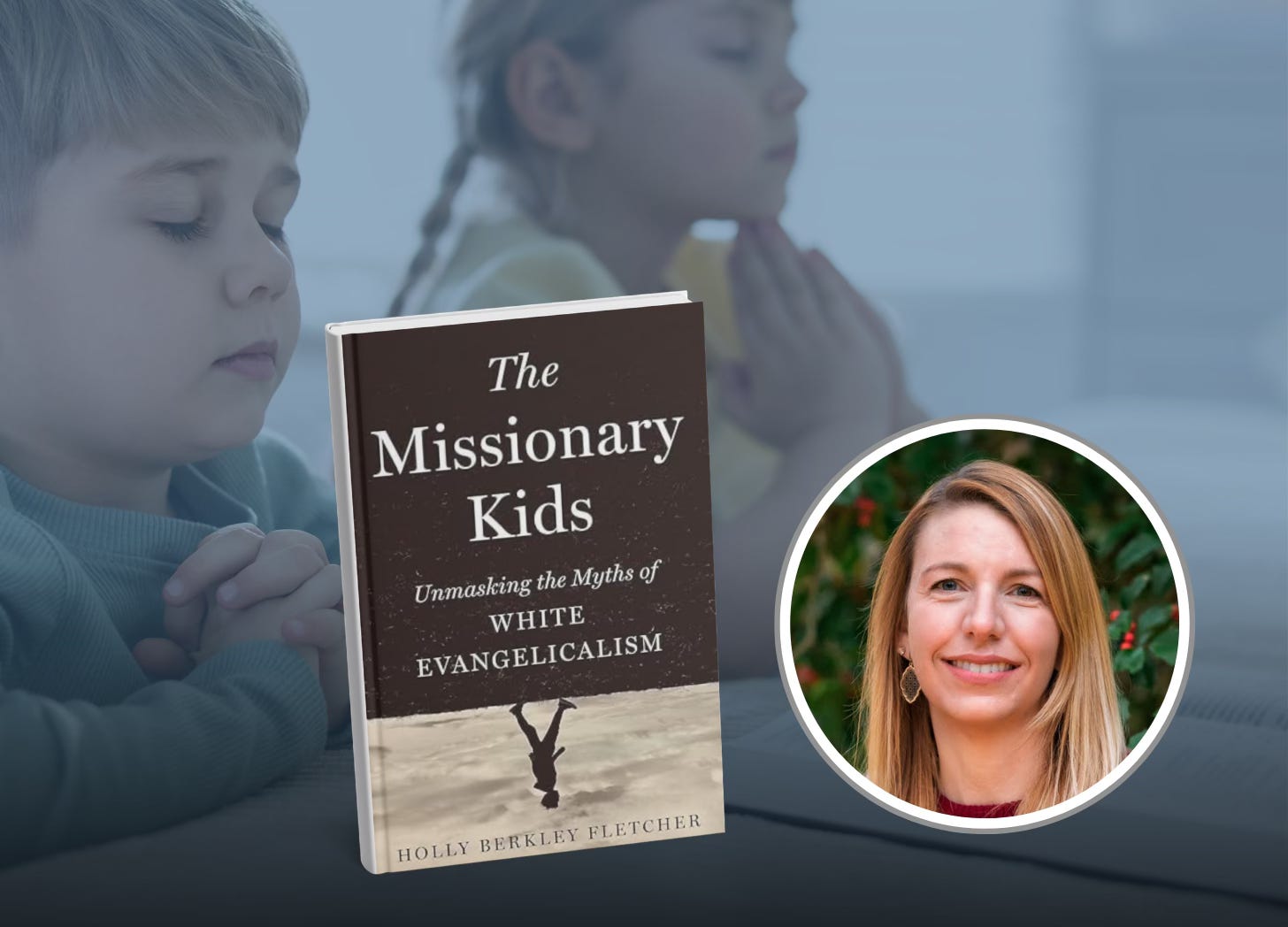
Missionary kids often carry the weight of their parents’ choices. They are inculcated into the faith without opportunity for independent thought, according to author, historian, and former intelligence analyst Holly Berkley Fletcher, PhD. Her parents were Evangelical Christian missionaries in Kenya, and she speaks about that and the experiences of other children with similar backgrounds through her 2025 book, The Missionary Kids: Unmasking the Myths of White Evangelicalism. “The mission field has long been the rugged frontier in a grand evangelical narrative, the ultimate proof of the American church’s virtue, rightness, and importance,” she writes in the book’s introduction.
Holly’s unique first-hand knowledge of missionary work has enabled her to explore the role of missionaries as “Super Christians” in the eyes of the church. Likewise, she has been able to write about the more devious aspects of mission culture, including physical or sexual abuse, neglect of children, and other crimes often not prosecuted due to jurisdictional gaps in the legal relationships between nations. Holly would eventually return to the United States, go on to teach at universities, and work for 19 years as an Africa analyst for the Central Intelligence Agency.
The Continuum of White Evangelicalism
Holly described the shades of White Evangelicalism along with the culture that surrounds it. “That’s why I love your model, because it is a continuum,” she said of the Influence Continuum© and BITE Model of Authoritarian Control™. “A high control religion can have a broad societal impact,” she explained. Then she noted that the Trump / MAGA movement “would not exist without white evangelicals.”
“That’s really the foundational, most solid support base that he’s had this entire time,” she concluded. She called White Evangelical Christianity a high-control religion with a persecution complex that has empowered a malignant narcissist. She said that’s what inspired her to write the book. “I felt like the missionary kid experience was a great way to shine a light on it, because it’s not a well-known facet to the broader public, but it is kind of the distillation of a lot of what white evangelical is.”
While reading her book, I noticed that the religion reflected both a male-centric and colonialist perspective, as well as a problematic treatment of children. As I put it, “The kids get farmed off to boarding schools and to other places, while the parents do God’s work.” Holly agreed, explaining that she specifically included the term “White” Evangelical Christianity because the racial dimension is deeply rooted in the culture. She acknowledged that while the movement has become global, with many White Evangelicals who are not white, “you see similar dynamics in other cultures replicating this both on the political front and on the religious front as well.”
Christian Nationalism and Manifest Destiny
Our conversation touched on the idea that America’s identity as a Christian nation has become central to the Trump administration’s mission, and how Pete Hegseth has framed the current conflict with Iran as a holy war. Holly explained the roots of this thinking: “Christian nationalism in our current political moment really stems from this idea of America is supposed to be a Christian nation. We’re the ones who are supposed to be in charge. And yet, culturally and demographically and religiously, the nation’s falling away.” She continued, “And so what you’ve seen in the last 20 years in particular is really a desperation, it’s fueled by a lot of fear and desperation that, oh my goodness, like we are losing power in this democracy.”
Holly then suggested that the final piece of this puzzle might be to do away with democracy altogether. “That’s when it gets really dangerous,” she said. We turned to the historical foundations of America, examining how religious freedom coexisted with Puritanical tendencies that ultimately led to spiritual oppression. She highlighted the enormous impact both Puritans and Quakers have had on American history and culture. Finally, we discussed the founding fathers’ commitment to the separation of church and state, a principle now rapidly eroding under the pressure of Christian nationalism.
Authoritarian Culture on Belief
Holly and I discussed how authoritarian cultures appear to be collaborating to consolidate control, and the persistent information warfare driven by high-control leadership. She also brought up James Talarico, the Texas Democratic state representative and Presbyterian seminarian, who has faced widespread criticism for his comments on Christian nationalism. “They’ve always seen liberal Christians as a huge threat, and I grew up being told that liberal Christians were not really Christians. Their faith wasn’t important,” she said. She then connected this to concepts of biblical inerrancy within the Evangelical Christian right, the belief that the Bible, in its original form, is entirely free from error.
Missionary Work and the Impact on Children
I asked Holly about corporal punishment in the White Evangelical world of missionaries. She said that while much of the physical abuse in boarding schools had fallen away by the time she attended, she felt constantly terrified by the ideas of hell as a mechanism of control. “I was always terrified that my faith was not deep enough, not committed enough, and that I would not make the sort of Heaven cut,” she said. She would recite the Sinners’ Prayer regularly in hopes of gaining salvation. “The school did not use corporal punishment. But again, the whole theological basis for white evangelicalism really instills a lot of fear, and the need to obey authority is a big part of that,” she said. I noted that this was the ‘E’ of the BITE model in phobia indoctrination.
Holly also discussed the pernicious aspect of separating children from their parents. She said that the distance created in that important relationship tended to make fear more prominent than an attachment based on love. “So, there was that with my own family dynamic, where I was just terrified of my parents, and I could more easily hide things from them, you know? So that trust was never really built,” she noted. I agreed and said that, as a mental health professional, thisis a kind of neglect and a lack of healthy identity formation.
Building Community vs. Conformity
Holly asked my professional opinion on the question “How do you build community without demanding conformity?” I said that it gets back to best practices within developmental psychology and healthy stewardship of children. “Parents should be viewed as stewards of their children, looking at their children as unique beings, and that their job is to steward their growth to independent adulthood, doing developmentally appropriate parenting with structure and discipline, not being too permissive or too authoritarian, but you need to be authoritative,” I said, “But most importantly, you need to role model good behaviors, because that’s how children really absorb, not what you say, but what, watching what mom and dad does, and having proximity.”
Holly then spoke about the idea of outsourcing our control to the church vs. struggling, and being encouraged to struggle, through difficult concepts of spirituality and faith. “There are certain people in particular who are drawn to these more high-control situations for whatever reason. But they do confuse conformity for community, and there is a difference. I just think community is harder. It takes more effort, right?” She said. I agreed with Holly’s thoughts on narcissism within high-control faiths and on the lack of empathy and compassion.
Finding Real Life Groups Focusing on Love vs. Fear
Holly expressed a founding principle in her current life to focus on finding groups that prioritize love rather than fear as a controlling principle. “It’s kind of like the force in Star Wars. The good side of force is love, and the bad side of the force is fear…what are you appealing to? What is your motivation?” We talked about the way we can share with one another through poetry and art, and how healthy leadership lifts people up. I noted a need for ‘all hands on deck’, as people need to focus on science, listen to experts, and become educated about civics. I shared how important Holly’s book was in this process and encouraged everyone to read it because credible scholars matter. We talked about the importance of supporting each other in this work. As we were closing our discussion, I said, “It takes a lot of villages, and it’s nice to meet fellow travelers, fellow survivors.”
Resources:
The Missionary Kids: Unmasking the Myths of White Evangelicalism by Holly Berkely Fletcher
Visit Holly on Instagram, Threads, BlueSky, LinkedIn, and Facebook
Check out Holly’s YouTube channel
There’s so much I could say here as a former MPK myself, but to the corporal punishment area, specifically — one of the countries in which my family were missionaries, corporal punishment was illegal. The white-evangelical-led missions organization in this country in the global south not only required that the missionaries use corporal punishment, but prominently taught locals to not follow their country’s laws around this because it “goes against God’s mandate”.
Missionaries have destroyed a lot of cultures worldwide.
My Icelandic grandmother's cousin was Vilhjalmur Stefansson, anthropologist and explorer (1879-1962). Between 1906 and 1918, he went on three expeditions to the Alaskan and Canadian Arctic, each trip lasting between sixteen months and five years. Stefansson's discoveries included the edge of the continental shelf, as well as a number of uninhabited islands in the Canadian Arctic.
Stefansson learned the languages of the Inuit, therefore he learned much more than others who merely asked questions. He lived for a number of years with the Inuit, learning their way of life. He was accepted as a member of the family and learned the culture as a child learns. This was a great advantage and stood him in good stead many times.
He said the Inuit had preconceived ideas about what the white man wanted and as a result would give answers to satisfy those preconceptions, whether they were true or not. Anthropologists worldwide have gradually come to the same conclusions, not only about the people they question, but also about the anthropologists' own preconceived ideas when they formulate their questions.
Stefansson observed the careless forest fires, burning acres in the Canadian wilderness, many caused intentionally and ignored by the Rangers. He observed the habitual cruelty of white men to the dogs - starving them, and killing or maiming them for entertainment. He observed the effect of the missionaries on the Indians and Inuits, which led to the rapid loss of their lifestyle and ancient traditions. First the traders, then the whaling ships, brought things the Inuit had never seen. These goods were first considered luxuries but soon became a necessary part of life.
From 1889 to 1906 the Inuit's lifestyle changed completely, from an independent self-sufficient people to a manipulated dependence on "civilized goods," such as sugar, flour, canned food, not to mention a Christian mindset. When he was with the Inuit in 1907, they had not yet been Christianized. But when he returned in the summer of 1908, they had all been converted. This resulted in acting against common sense, such as not doing anything on the Sabbath for fear they would go to hell. Such is brainwashing.
During the summer of 1908, only one whaling ship managed to make it through the ice. The ice floes, instead of moving parallel to the coast, jammed up against it because of a change in the winds. The Inuit, who had become used to imported luxuries, felt deprived and were on the verge of starvation, forgetting that their ancestors had survived for thousands of years on caribou and fish. Stefansson made many observations on the relationship between health and diet, and wrote several books on the topic. On that trip, Stefansson had been intending to live off the land, but realized that, where there had been thousands of caribou ten years before, now there were very few; they had been wiped out like the buffalo in America. In America, the buffalo inhabited land needed for farming, but that wasn't the case in Canada or Alaska. They were simply slaughtered for mindless entertainment.
After a serious illness in 1918, Stefansson left the Arctic forever. However, he had a rich, full life after the Arctic. As a famous explorer, he gave lectures, wrote 24 books, including his autobiography, and more than 400 articles on his travels and observations.