


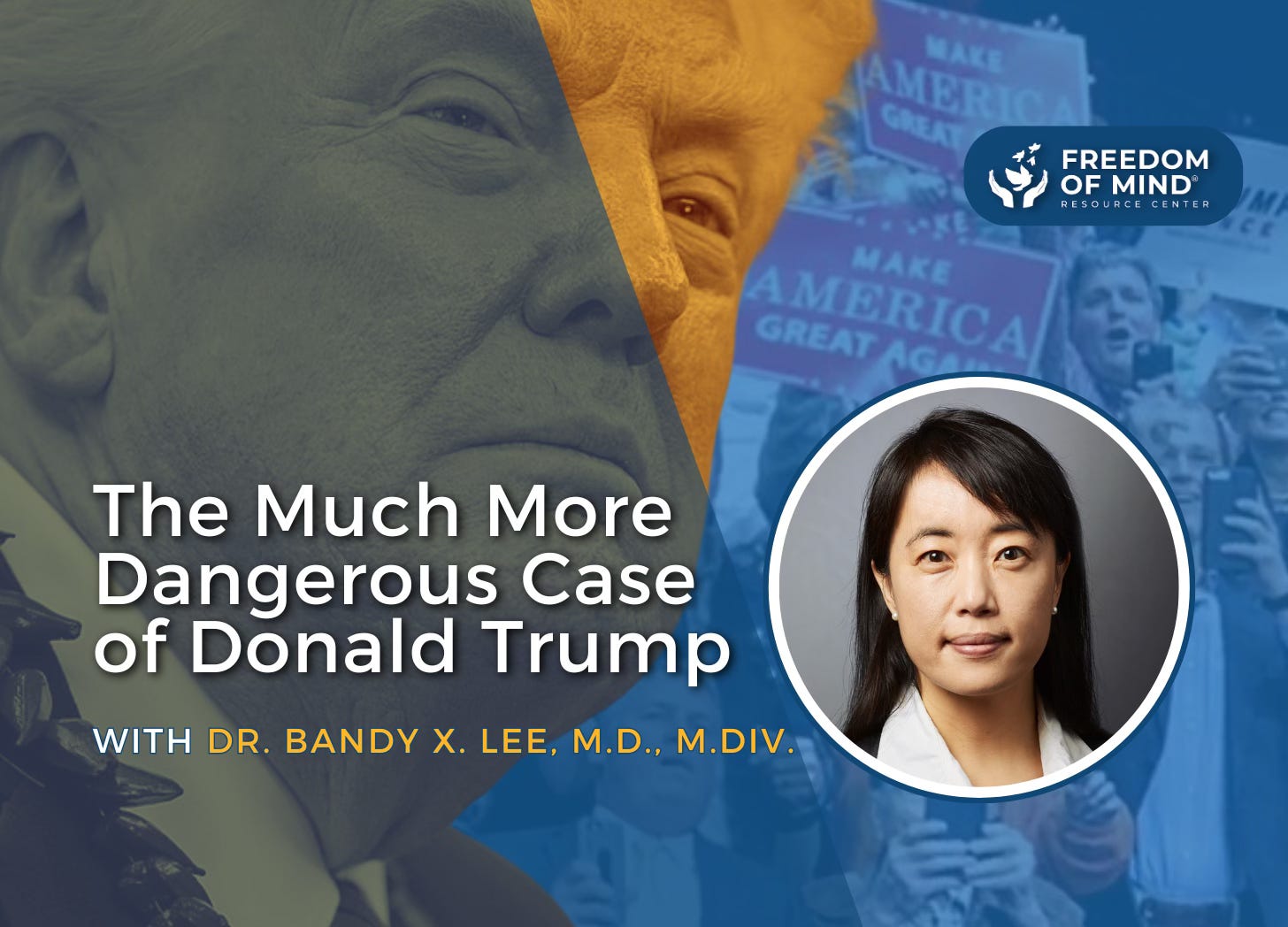
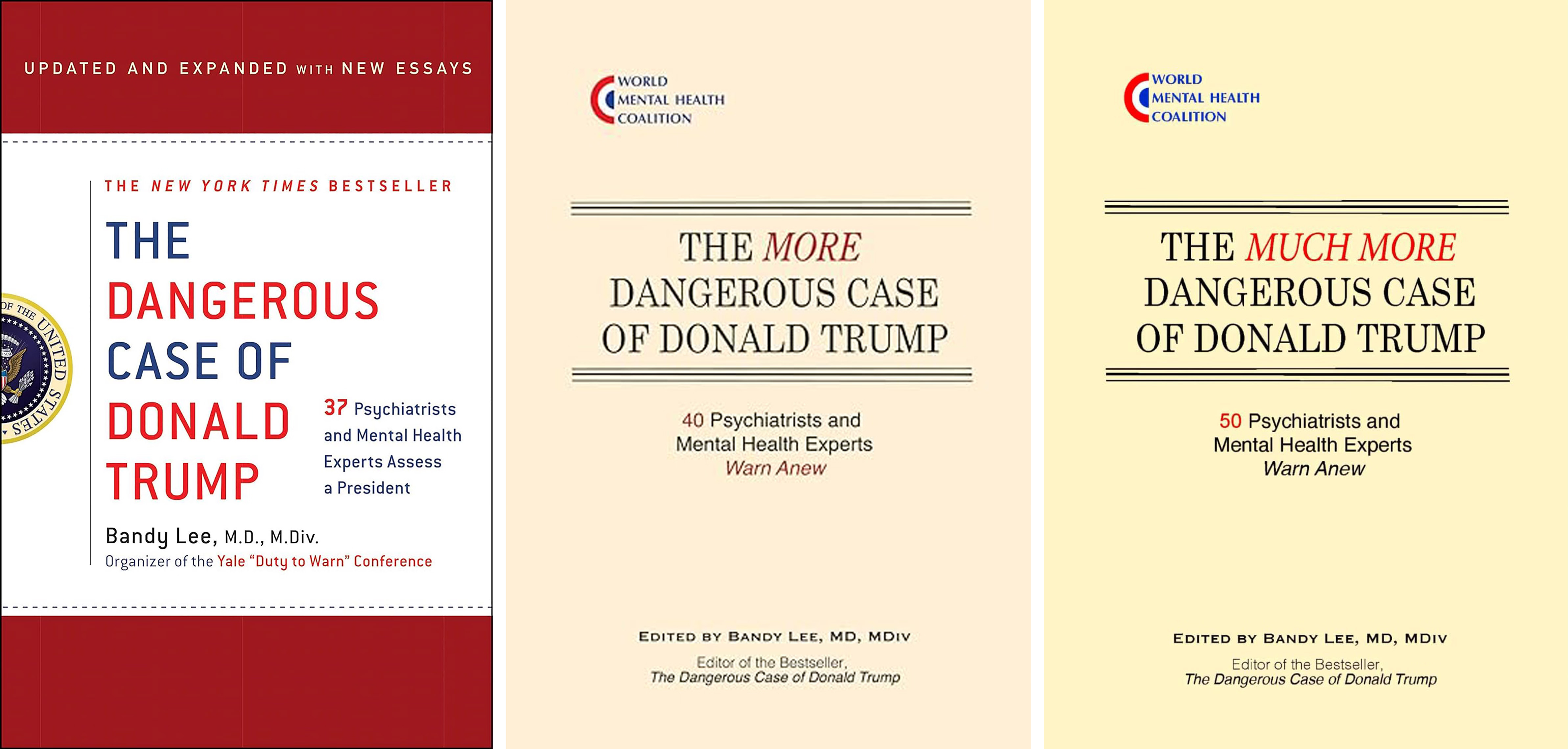
Dr. Bandy X. Lee, M.D., M.Div., is a forensic psychiatrist and internationally recognized expert on dangerousness. She is the editor of the New York Times bestseller The Dangerous Case of Donald Trump: 27 Psychiatrists and Mental Health Experts Assess a President (2017). She followed up with The More Dangerous Case of Donald Trump: 40 Psychiatrists and Mental Health Experts Warn Anew (2024) and The Much More Dangerous Case of Donald Trump: 50 Psychiatrists and Mental Health Experts Warn Anew (2025). She has consistently been vocal on her views that President Donald Trump presents a Mental Health Emergency, which threatens our nation and the world.
Dr. Lee has taught at Yale School of Medicine and Yale Law School from 2003 to 2020. She has published over 100 peer-reviewed articles and chapters, 17 scholarly books and journal special issues, and more than 300 opinion editorials on outlets such as the Guardian, New York Times, Boston Globe, The Independent, Politico, and many more. She is the President of the World Mental Health Coalition and specializes in public health approaches to violence prevention. She has consulted with the World Health Organization and advocated for prison reform in the United States. In addition to psychiatry training, she also holds a Master of Divinity.
The APA Wrongly Used the “Goldwater Rule” to Silence Mental Health Professionals
We were fortunate to have Dr. Lee return to this episode of Cult Conversations: The Influence Continuum to give us her updated concerns and recommendations on the nation under Trump’s continued authoritarian takeover. She began with an explanation of her original concerns for his first presidential term: “We spotted what many just assumed was a different style, or they didn’t know what to make of what he was bringing to the table, because most people are not exposed to such extreme degrees of mental impairment, especially in the realm of personality disorders, and of course, that’s my area of specialty.” Dr. Lee, deeply concerned, met with colleagues and gathered other mental health professionals in 2017 for a ‘Duty to Warn’ conference at Yale School of Medicine.
Soon after, medical professionals speaking out about their concerns for the stability of Trump’s mental health began to be publicly criticized for violating the American Psychiatric Association’s (APA’s) so-called “Goldwater rule.” This rule, applying only to members of the APA by agreement (since it violates the First Amendment), is a statement of ethics that supposedly prohibits diagnosing public figures without personal examination and consent. Dr. Lee had resigned from the APA a decade earlier, on other objections. She also explained that in early 2017, the APA changed its interpretation of the rule to be more far-reaching. “We were not talking about diagnosis here. We were talking about danger to society and potential unfitness, which are public health concerns, not personal, private diagnosing for private patient treatment situations. However, the APA conflated the two and said that the Goldwater rule meant no comment whatsoever, not just diagnosis. That was the shocking part of it,” Dr. Lee said. She continued: “That was when the APA came in and said we were being unethical, we were armchair psychiatrists, politicizing psychiatry for self-aggrandizing purposes,... using language I never saw a professional association use, but it had a toxic public relations effect.”
The result of this censorship is that medical professionals were not speaking out openly, or were blocked from speaking out openly, on the topic of the current mental health status of United States President Donald Trump. Mental health professionals nationwide largely remained silent on his fitness for office and still do so today, which is the equivalent of silencing infectious disease experts during a Plague. “The world is wondering why we haven’t solved this problem. It was because the APA blocked the most important experts from educating the public and intervening properly,” Dr. Lee said.
Evaluating the Dangerousness of a Public Figure
“Dangerousness is a functional assessment and has nothing to do with clinical diagnosis. In fact, it’s based on objective observations, especially seeing the person in their functional role, whatever their office may be. That kind of evaluation is far more valuable than a personal interview,” Dr. Lee said. “In fact, for those who have some of the most dangerous personality disorders, it is better not to interview because they present with incredible charm. They are beguiling. They can hypnotize people, especially crowds. That’s why some political and social psychologists have called them ‘spellbinders, ’” she continued.
Dr. Lee noted that what is valuable in evaluating danger in individuals includes collateral reports, objective records, documentation, and objective observation of them over time in their functional role. I noted that in Trump’s own words, he stated that he could stand in the middle of Fifth Avenue and shoot someone without losing followers. More dangerous than simply personal violence, Dr. Lee said that the threats of violence may even have more impact. “Dangerous rhetoric can be far more deadly than personal violence. In fact, some of the greatest mass murderers in history never killed a person themselves, but have instituted rhetoric, cultures of violence, and policies of violence,” she said.
Remove the Violent Kingpin to Restore Health in Followers
Dr. Lee and I discussed how best to move forward from this point and how she has seen violent organizations heal after undue influence. “I have seen repeatedly how gang leaders, prison kingpins, and those who lead these groups with severe psychiatric symptoms—just like Donald Trump—who are violence-prone and collect followers. Once they are removed from their position of influence, removed from contact, all the followers usually return to their baseline state of functioning, which is usually healthier than the leader,” Dr. Lee said. She noted that this falls under psychiatric concepts of shared psychosis and induced delusions. “It’s more a phenomenon than a personal diagnosis, because it happens when there is a dominant figure with severe mental symptoms who either recruits or isolates followers from other gangs or other environments where they could gain broader information, and then these followers come to take on the same psychiatric symptoms as the leader,” she said.
I brought up a new book by neuroscientist Emily Falk called What We Value: The Neuroscience of Choice and Change, and the FMRI (Functional Magnetic Resonance Imaging) findings showing how, as social animals, our brains entrain to those around us and what we are listening to. Dr. Lee agreed and noted the interconnectedness of mirror neurons and other bio-psycho-social mechanisms of systems. “We need to improve our mental health, and the way to do so is to start by education, which is a main public health intervention,” she replied.
I reminded listeners, “Don’t give up hope, and don’t silence yourself in advance.” Dr. Lee agreed: “We see what happened to all the universities when they caved in. They are more targeted, the same as the media, and we cannot capitulate in advance, which places us in greatest danger.”
Resources:
Video of the October 2024 press conference given by the World Mental Health Coalition, ‘The More Dangerous State of the World and the Need for Fit Leadership’ - Full playlist (including Dr. Bandy Lee, Dr. Steven Hassan, Dr. Robert Jay Lifton, Dr. Joseph Romm, and more)
The Dangerous Case of Donald Trump
World Mental Health Coalition Books
Previous blog posts and interviews with Dr. Bandy Lee:
The More Dangerous Case of Donald Trump: 37 Psychiatrists and Mental Health Experts Warn Anew - August 12, 2024
The Dangerous Case of Donald Trump and Censorship of Experts with Bandy X. Lee M.D. - August 31, 2023
The Public Health Disaster of Donald Trump, a Narcissistic and Sociopathic President - February 16, 2022
Dr. Bandy Lee and Dr. James Gilligan: Do We Surrender Our Moral Compass to Technical Rule? - March 7, 2019
Yale Forensic Psychiatrist Bandy Lee Discusses the Dangerous Case of Donald Trump - January 28, 2019
I primary care Geriatrics we worked closely with Psychiatry and I learned how to recognize these traits. It was also honed by caring for persons with dementia as a lot of psychotic symptoms in dementia can mimic personality disorders. What's really interesting is watching what happens to persons with these disorders when their long standing coping mechanisms stop working as they age. That often brings them in to see a psychiatrist. As for Dr. Lee warning the public we see how well that works in the example of RFK, Jr. No one pays any merit and then we have damage that could have been avoided.
I was appalled and fascinated by the “spell binding” phenomenon and the hypnosis that a personality such as DT can use on groups. My daughter’s former husband had the special talent. It was, at first, annoying but became terrifying as time went on. I would like to read more about it.