


Social identity, or how the portion of our identity we derive from participating in our social groups, can expand our mind or limit our ability to embrace complexity and nuance.
Why should this matter to someone who has never joined a cult? Because every one of us moves through families, workplaces, political communities, faiths, fandoms, and online networks. We are constantly being influenced, day in and day out, by every single person we meet.
Social identity belongs at the center of a conversation about freedom of mind, connecting the intimate pressure to fit in with the public systems that reward some voices while punishing others.
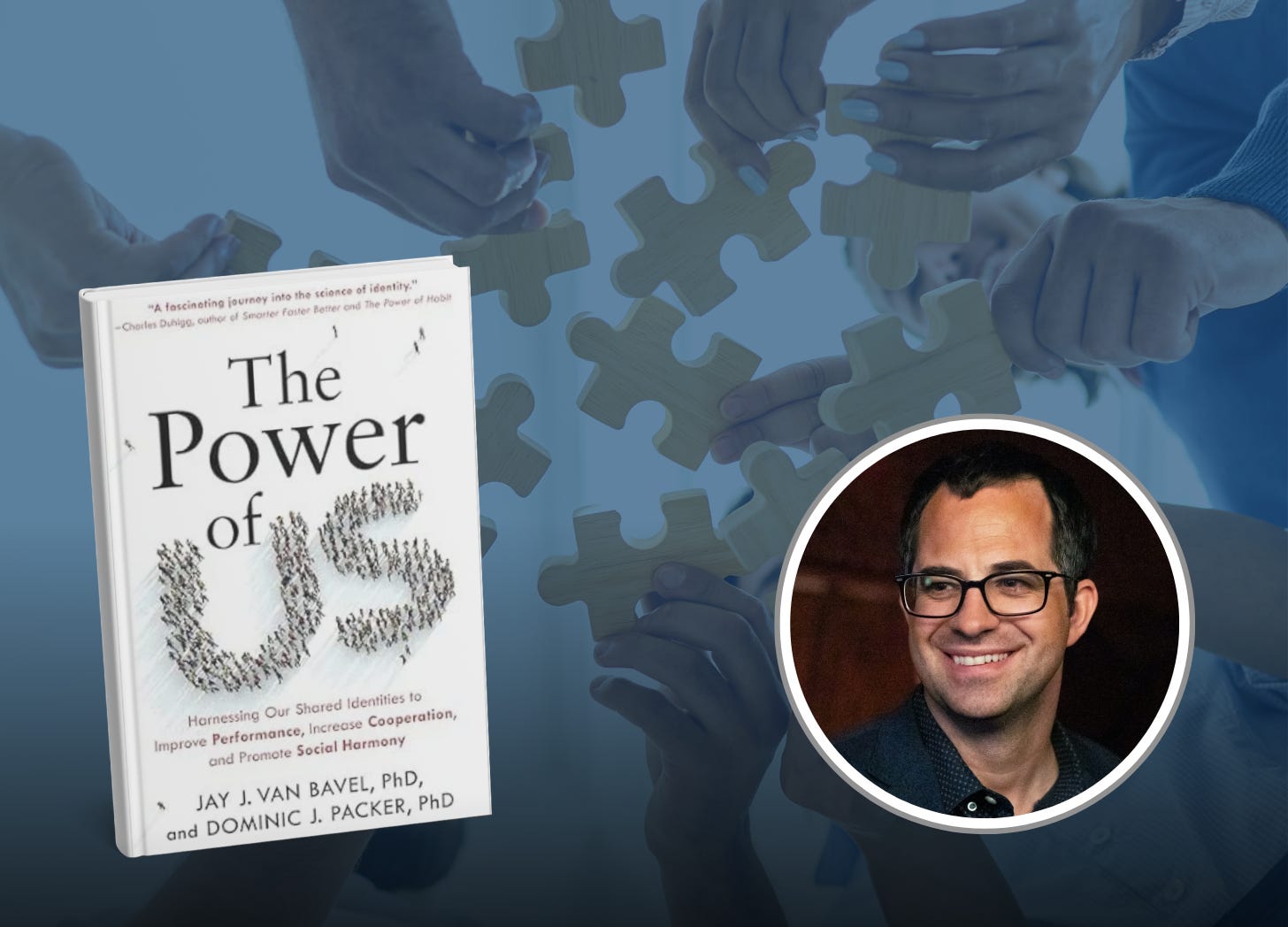
That tension guided my conversation with Jay Van Bavel, author of The Power of Us: Harnessing Our Shared Identities to Improve Performance, Increase Cooperation and Promote Social Harmony. He is a professor of social psychology and director of the Center for Conflict and Cooperation at New York University. The Power of Us explores how we experience the world and what shapes our perception day to day. It asks why disagreeing with others has become so difficult, and what has driven such a rise in hostility.
Van Bavel’s book also uses Enron as its “cultish company,” drawing on Dennis Tourish and Naheed Vatcha’s 2005 study of the firm as a corporate cult that rewarded conformity until it collapsed.
Van Bavel earned his PhD at the University of Toronto, where his co-author, Dr. Dominic Packer, was his office mate and, in one of the better origin stories in academic publishing, the man who saved him from choking on a cheese cube at a faculty wine-and-cheese event.
The Algorithm Rewards the Demagogue
For a decade, Van Bavel has studied these group dynamics online. With William Brady, he found that each additional “moral emotional” word in a post—disgusting, hate, evil —increased sharing by roughly 20%.
He also analyzed millions of posts from news outlets and members of Congress with Steve Rathje and Sander van der Linden, finding that every term referring to a political “out group” raised the odds of a post being shared by 67%. Contempt for them, the people we are told are our enemies, is the most reliable engine of virality yet measured.
Notably, this only works in one way. It seems that people on the other side don’t argue back; instead, they disengage and rate the speaker as closed-minded.
Van Bavel teaches us that this is “a double-edged sword” in that it rapidly encourages action by people like you while putting you “in an echo chamber of people only like you.”
These reactions are further weaponized against us. In 2021, The Washington Post reported that Facebook’s algorithm had, since 2017, treated a reaction emoji as five times more valuable than a like, quietly boosting whatever made us emotional.
“This is something that you see in any really dysfunctional group as they try to cut you off from other sources of information, especially ones that are accurate.” Van Bavel noted.
“And to the extent that they do that, you become dependent on them, not just emotionally and socially, but cognitively about what the state of the world is and what to believe. And then once you have that, it’s very hard to escape that. You get trapped in their universe.”
We Contain Multitudes… Until a Group Takes Them Away
My Influence Continuum runs from groups built on free will, informed consent, and accountable leadership at one end to the BITE Model of Authoritarian Control™ at the other.
It is important, knowing this, to understand that intense devotion is not the problem itself. A sports fandom, while showing up yelling, chanting, with faces painted, has no deceptive recruitment, no phobia indoctrination, and no ban on what you may read.
We contain multiple identities, and the situation decides which one switches on. As I have before, Van Bavel also uses the example of a devoted Taylor Swift fan. A Swiftie at a concert is fully immersed, wristband lit, singing every lyric, then goes home as a parent and heads to work as a professional.
“No one is drinking the Kool-Aid at a Taylor Swift concert,” he noted.
What an unhealthy, immersive group does is take away the other aspects of our social identities. These groups cut us off from family, friends, and work. One principal identity is the main operational one.
The rationalizations, Van Bavel added, are rarely something you generate alone. In your living room, alone, an excuse for a failed prophecy doesn’t hold. However, when you are surrounded by people rationalizing together, it does. Van Bavel sees hyperpartisan media performing the same service.
“A lot of times it’s not explicit misinformation; it’s rationalizations for things that don’t otherwise fit.”
The Antidote to Cult Psychology
In a group setting, the burden often falls on the leader not only to allow dissent but also to encourage it.
“Groups that have a dissenter reach better decisions than groups that don’t have a dissenter, even if the dissenter is wrong,” van Bavel points out.
This idea is inherently counterintuitive. After all, how can a wrong answer help? It works because encouraging active dissent and disagreement sets a norm. Someone has to poke the first hole in the plan, and after that, the person with the right objection is primed and comfortable to speak up.
Dissenters are usually not the detached members but the ones who identify most strongly with the group and are frightened about where it is heading. Van Bavel points out that we often punish them.
“How do you think we treated heretics throughout history? Or, in companies, the term we have for them is "devil’s advocate." Can you think of a worse name to call a human being than a devil’s advocate?... Usually, it’s the person who cares the most and is deeply worried about the group and still has some hope that the group can repair itself.”
So, the burden often falls on leaders to encourage this dissent. Van Bavel brings up Nelson Mandela’s rule that leaders should speak last and now bites his tongue in his own lab meetings — which is how he learned his graduate students had ideas they were swallowing.
He described eBay’s executives passing around a literal black motorcycle helmet, worn by whoever was assigned to attack the day’s proposal, so dissent became a rotating duty rather than a perceived attack on company ideas.
None of us likes being exploited, lied to, or manipulated. Freedom of mind is not only freedom from undue influence in our groups or relationships, but also the ability to belong without suppressing or even surrendering our other identities.
Van Bavel’s work teaches that the power of “us” need not capture the mind. We can build institutions and online communities in which dissent is treated as a strong contribution and where people can change their minds without losing their place among others.
Listen to the full episode and consider one question about the groups that matter most to you.
Do they help you think more freely, or teach you which thoughts you are allowed to have?
Further Reading
Check out Jay’s The Power of Us Newsletter, or visit him on BlueSky, LinkedIn, X/Twitter, Instagram, Threads, YouTube, or TikTok.
Here is Jay’s Linktree: https://linktr.ee/jayvanbavel
The Power of Us: Harnessing Our Shared Identities to Improve Performance Increase Cooperation and Promote Social Harmony by Jay J. van Bavel PhD and Dominic J. Packer PhD
Foolproof: Why Misinformation Infects Our Minds and How to Build Immunity, with Sander van der Linden, Ph.D. - On psychological inoculation and why prebunking beats debunking.
STRONGMEN: Mussolini to the Present — The Rising Tide of Online Authoritarian Influence, with Ruth Ben-Ghiat - The historian of fascism on how authoritarian leaders build loyalty networks and eliminate dissent.
End Time Politics: From the Moral Majority to QAnon, with Keri L. Ladner, Ph.D. - How apocalyptic religious movements grew into a mass political conspiracy infrastructure.
Facts Matter When Unraveling the MAGA Mindset - Featuring my mentor Robert Jay Lifton, whose eight criteria of thought reform helped me get out of the Moonies.