
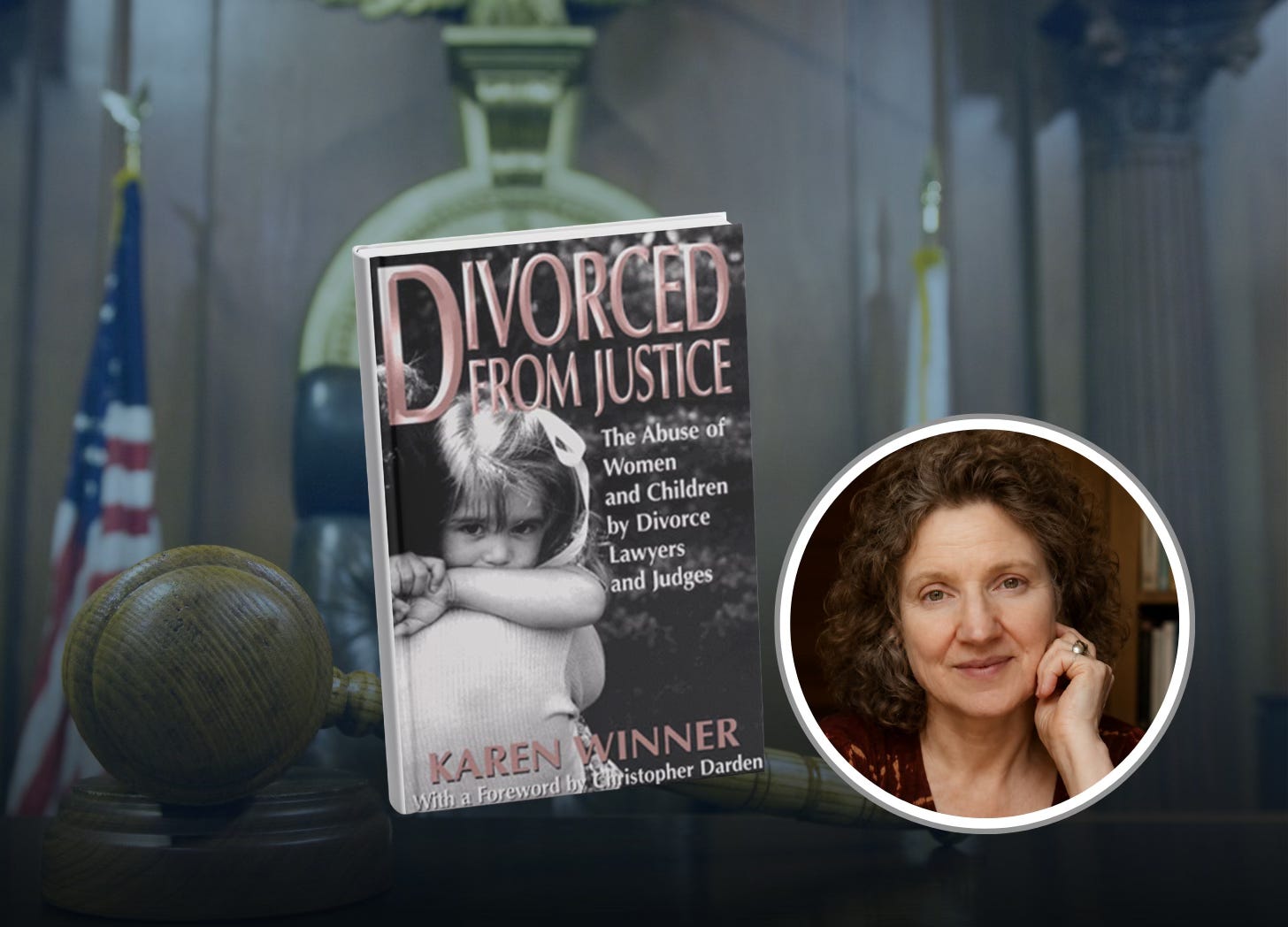
A family court judge can reach into your family, single you out by name, and rearrange your life by dinnertime: where your child sleeps tonight, whether you’re allowed to see them, whether you’re even permitted to raise a concern about your spouse. Karen Winner told me that in the opening minutes of our conversation, and it’s the line I keep coming back to. Winner is a journalist turned attorney and the author of Divorced from Justice: The Abuse of Women and Children by Divorce Lawyers and Judges, a book that started as a government investigation and became one of the few serious accountings of how family court actually operates in this country.
Winner’s path into this work began at the New York City Department of Consumer Affairs, where she investigated financial abuse of women by their own divorce attorneys under Commissioner Mark Green. Three women brought her their stories, including Monica Getz, the ex-wife of saxophonist Stan Getz, and Peggy Hammond, ex-wife of blues musician John Hammond Jr. Winner went on to interview roughly a hundred people inside the system, insiders included. One judge pulled her aside in an empty courtroom to whisper how the wealthy get exploited by their own lawyers. The resulting report led to New York’s Statement of Client’s Rights, one of the first consumer protections written specifically for divorce clients, and still law today.
Why Family Court Operates Like a Closed System
What struck me most was Winner’s explanation of judicial discretion. Family court judges, she said, “operate without any checks and balances.” They decide behind closed doors, rarely have to explain their reasoning, and face almost no outside scrutiny because the whole apparatus runs at the state level.
Custody evaluations compound the problem. Courts routinely appoint psychologists to assess parents, but “there’s nobody reviewing the reviewers.” Their reports are often sealed from the public and, astonishingly, from the parents whose children’s futures depend on them. “It’s not fair,” Winner said. “It’s not democratic. It’s Kafka.” A small, favored pool of evaluators gets reused case after case, regardless of credentials, because judges default to whoever they already know.
That is the same undue influence dynamic I study in destructive cults: a closed information environment where the people affected by a decision have no way to question the process that produced it. When Bandy Lee joined me on this podcast, she described family courts as functioning like “a mini cult,” advancing a false narrative that protects the wrong parent while the public stays in the dark.
When the People Policing Lawyers Protect Them Instead
Winner’s most chilling material concerns what happens when a lawyer breaks the rules. In most states, complaints against attorneys stay confidential unless regulators pursue them, meaning a lawyer can accumulate a hundred complaints with no single complainant ever learning about the others. That secrecy, she told me, is exactly what let Roy Cohn, the disbarred McCarthy-era prosecutor who later mentored Donald Trump, keep practicing as a divorce lawyer for years while complaints piled up unseen. Cohn wasn’t disbarred until June 1986, months before his death (Washington Post).
Winner described a client whose lawyer forged her signature on an affidavit surrendering her child support, a forgery confirmed by a handwriting expert. The grievance committee still declined to act, telling the woman to file a separate civil suit against the same lawyer representing her in an active divorce. “Lawyers write the rules to protect lawyers,” Winner said. It’s a pattern I recognize from every closed system I’ve studied: those with the power to investigate wrongdoing are drawn from the same pool as the people who might commit it.
Parental Alienation and the Limits of Family Court
We also debated parental alienation, a genuinely contested area. Winner cited research showing that a protective parent actually coaches a child to make false abuse claims in fewer than two percent of custody cases, yet she said the alienation defense is routinely used by parents accused of abuse, often successfully, to win custody anyway. I pushed back with a case I testified in, Kendall v. Kendall in Massachusetts, where a father’s Bible-based group told their child that her Jewish mother was going to hell. The Massachusetts Supreme Judicial Court sided with the child’s welfare over the father’s religious claims. Winner and I didn’t fully agree on where the line sits, but we agreed the underlying dynamic, one parent systematically turning a child against the other, is real and devastating, regardless of what a family court chooses to call it.
What Actually Changes a Broken System
Winner isn’t without hope. England and Wales have rolled out a reporting pilot that lets journalists sit in on family court proceedings, with names redacted, a change the judiciary there called a “watershed moment for family justice” (Courts and Tribunals Judiciary). The United States has no equivalent. In the meantime, Winner points to court watcher programs, ordinary volunteers who sit in the gallery and observe. She told me studies show judges behave differently when someone is watching, which is really just social psychology: unaccountable power corrects itself only when accountability is added back in.
Winner is now working on a second book examining wrongful custody rulings as documented miscarriages of justice, including a case where a judge later resigned rather than face investigation after taking a trip with a father’s attorneys, only to leave her prior custody decisions untouched. That is the throughline of everything Winner and I discussed: systems built on secrecy don’t reform themselves. They need outside eyes, whether that’s a journalist, a court watcher, or a family member who refuses to accept that “the judge said so” is an explanation.
Further Reading
Divorced from Justice: The Abuse of Women and Children by Divorce Lawyers and Judges by Karen Winner
Framed: Women in the Family Court Underworld — My conversation with Dr. Christine Cocchiola and Amy Polacko on their book documenting how protective mothers are set up to lose in family court.
Parental Abduction and Alienation: A Discussion with Psychiatrist Nick Child — How the tactics used to alienate a child from a parent mirror the coercive patterns found in cults.
You-Know-Who: An Alienated Daughter’s Memoir with Dana Laquidara — A firsthand account of growing up alienated from a parent, and what it took to reconnect decades later.
The Dangerous Case of Donald Trump and Censorship of Experts with Bandy X. Lee, M.D. — Dr. Lee and I discuss family courts functioning like a “mini cult” that protects the wrong parent.
Alienated from her Mother at Age 4, Parental Alienation and Patterns of Cult Mind Control — On parental alienation as a standard operating procedure of undue influence, inside cults and outside them.


