


“The Russian plan was to ‘destroy a democracy by using the democracy’”
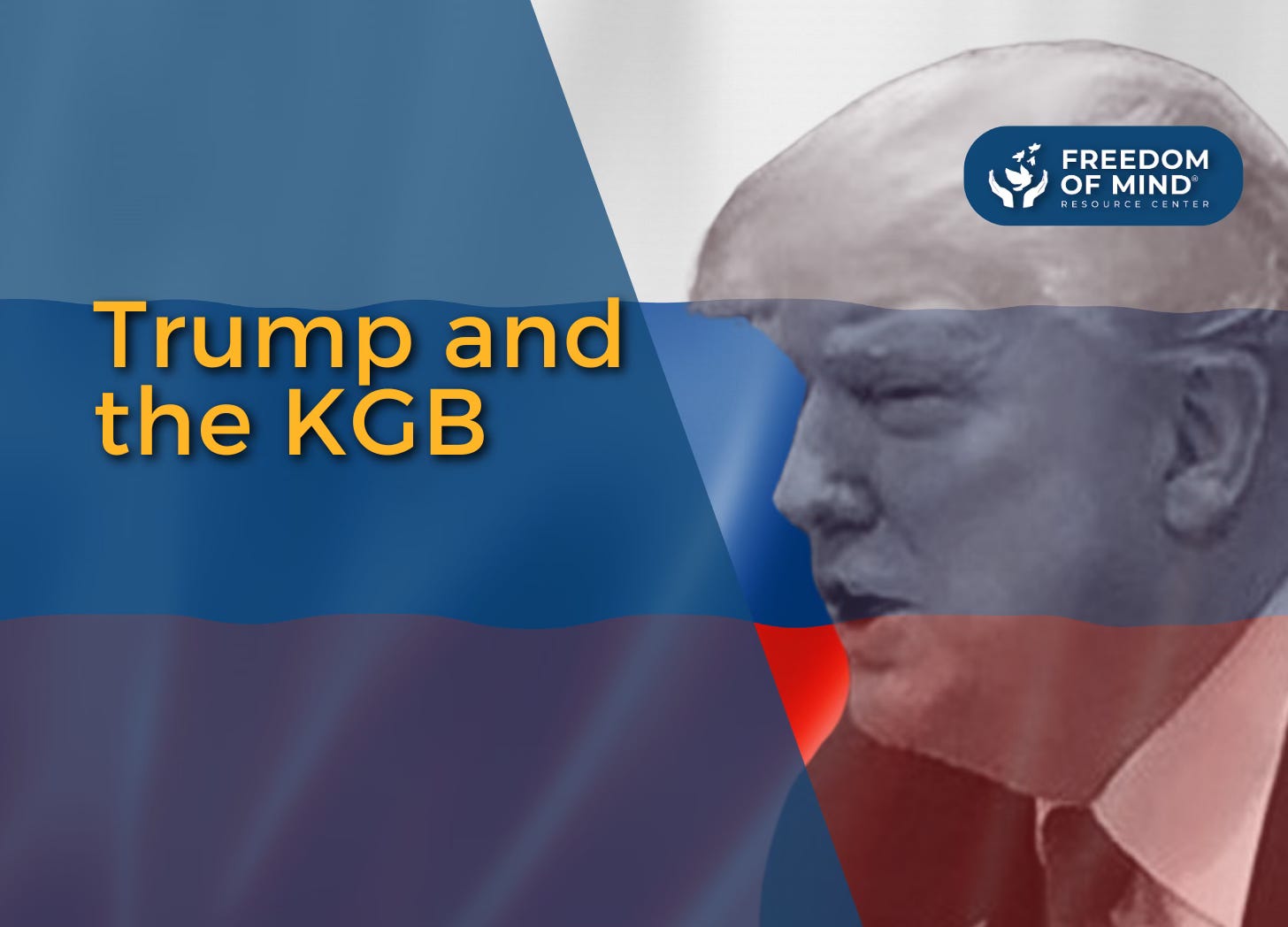
I’ve spent my career examining how cult-like leaders influence followers. I’ve dealt with many leaders who use psychological coercion to control their followers. But none have been so flagrantly supportive of authoritarianism as Donald Trump. His close ties with Russia, his open admiration for Vladimir Putin, and the evident similarity between his tactics and KGB strategies pose a danger to the status of American democracy.
Mainstream media and popular culture are beginning to catch on and report about Donald Trump’s history with Russia and the KGB. We must continue discussing these connections, as they have profound implications for our democracy and national security. In the past few days, The Guardian, The Economic Times, and The Daily Beast all reported on this information.
New Breaking News
A former top KGB official, Airur Mussayev, claimed in a Facebook post-Friday, February 21, that his team attempted to recruit Trump into the KGB in 1987 while he was in Moscow checking out potential real estate projects.
In his post, Mussayev explained:
“In 1987, I worked in Moscow's 6th Department of the KGB of the USSR. That year, our department recruited the 40-year-old businessman from the USA, Donald Trump, nicknamed ‘Krasnov.’”
There is no documentation of proof of Mussayev’s claim. However, this aligns with what other former KGB officials, such as Yuri Shvets, said in Craig Unger’s book, American Kompromat. I interviewed them both in 2021 in two parts for my Freedom of Mind blog, which now lives on Substack. I made these two blogs free for the public. However, I recommend watching the entire one-hour video at a minimum.
So, what was the KGB? (Now it is called the FSB, I am told)
The Komitet Gosudarstvennoy Bezopasnosti (KGB), or Committee for State Security, functioned as the secret police, espionage network, and propaganda machine of the USSR from 1954 to 1991. It was the Soviet Union’s version of the Central Intelligence Agency (CIA) of the United States.
The KGB, during the Cold War, was in a race with the CIA for researching and developing methods of mind control. Many people have heard of MKUltra. Alan Scheflin, law professor emeritus, wrote one of the first books, The Mind Manipulators, about this project. Before Scheflin passed away, he and I co-authored two chapters on the “dark side of hypnosis” for a textbook on clinical hypnosis. Alan’s chapter focused on MKUltra, and my chapter focused on Scientology, NXIVM, and other cults that use hypnosis, including NLP.
In all fairness to the Russian people, the CIA has a long history of engaging in mind control on America’s adversaries. In short, the USA has dirty hands, too. Retired General Michael Flynn was a master of 4th and 5th generation psychological warfare for the USA.
One of the biggest disappointments in my 49-year career since my deprogramming from the Moonies is the American government has not been honest with its citizens about the reality that minds can be radicalized.
I will never forget after the Jim Jones cult (also known as the Peoples Temple) murdered congressman Leo Ryan, ABC did a special on mind control, and the CIA’s former top psychologist John Gittinger went on camera and said, yes, the CIA ranMKUltra. He claimed they didn’t find anything that worked. It is true LSD did not prove to be an effective tool for creating a Manchurian Candidate, but hypnosis WAS a tool that could bend minds effectively in a controlled way.
It has been my life's work, as a victim of a mind control cult, to explain to citizens of the world about the reality of mind control. For those who have read my book, Combating Cult Mind Control, I shared my research into the reality of the CIA setting up the Korean CIA and the founder of the KCIA saying, under oath in a congressional subcommittee investigation into KCIA activities in the United States, that he “organized and utilized the Unification Church for use as a political tool.” I was recruited on the campus of Queens College in February, 1974, in an effort by Nixon to recruit students to oppose the anti-Vietnamese war movement. I have long told people I believed I was MKUltra 2.0 or perhaps 3.0 as I would have killed or died on command—believing I was following the Messiah—Sun Myung Moon.
The USSR’s KGB was quite expert in researching and engaging in brainwashing. Mao learned about brainwashing from the Communist Soviet Union! They were a psychological warfare machine, mastering the art of mind control, disinformation, and manipulation to shape global events in the Soviet Union’s favor. Their tactics—still in use today under the Russian FSB—include:
• Counterintelligence – Infiltrating and neutralizing perceived threats, both inside and outside the Soviet Union
• Political Surveillance – Monitoring dissidents, intellectuals, and opposition figures to ensure obedience
• Influence Operations – Spreading propaganda and disinformation while running psychological operations to destabilize enemy nations
• Kompromat – The strategic use of blackmail, often involving sex, money, or crime, to control key figures in business, politics, and media
• Recruitment of Western Influencers – Identifying and cultivating individuals in the West—often businessmen, media figures, and politicians—who could be leveraged to serve Soviet interests
“Russia deployed thousands of cyberterrorism agents to find ways to hack into the American psyche, systematically targeting individual Americans with lies, misinformation, and false narratives tailored to their interests and framed in ways that were intended to confuse, divide, and pit Americans against one another.”
— The Cult of Trump
The KGB was an engineered cult of control, ensuring that individuals acted not in their own interests but in the interests of the Soviet Union.
The Cult of Trump Connection
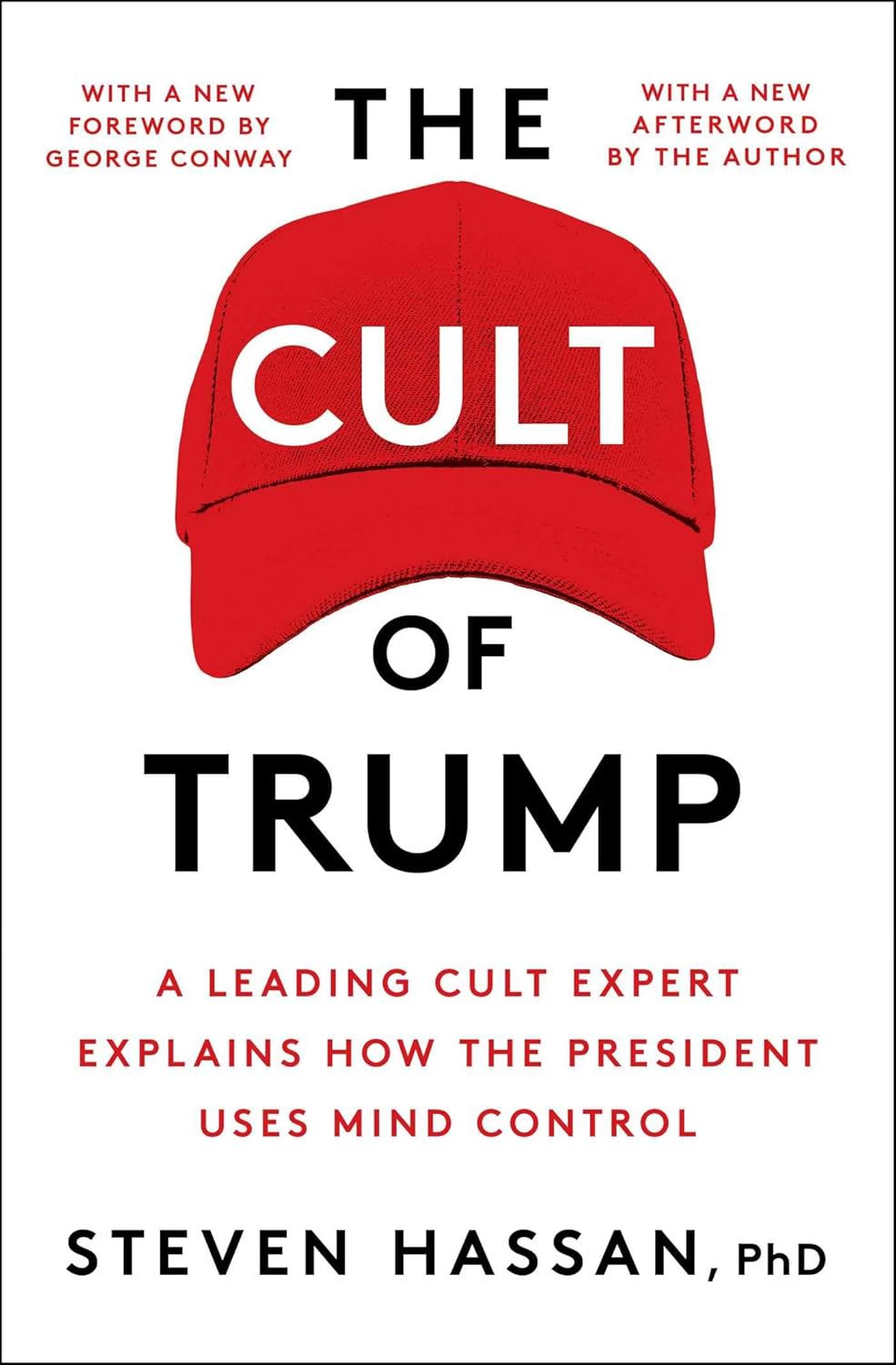
In The Cult of Trump, I further explore the links between President Donald Trump and Russia.
Donald Trump’s associations with Russia date back decades. In 1987, he visited Moscow on a trip that the Soviet government arranged. Trump was a little-known real estate developer at the time but received VIP treatment and met with senior officials, no doubt under KGB surveillance. The KGB actively cultivated influential Westerners, and Trump, an ambitious, recognition-hungry businessman, was an obvious target. Soon after his trip back, he took out full-page ads in the three major U.S. newspapers advocating a shift in U.S. foreign policy that was advantageous to Soviet interests. In the 1990s, Russian oligarchs invested heavily in Trump’s properties, but Trump was in financial difficulties.
In retrospect, Putin, a former KGB agent, has long sought to weaken alliances and destabilize democratic institutions. Trump’s current policies—such as cutting Federal funding, recently undermining NATO, and downplaying Russian election interference in the 2016 election—align closely with Putin’s goals.
Recently, Trump called out Ukrainian President Volodymyr Zelensky a “dictator without elections” even though he fairly won in 2019 and suggested that Ukraine initiated the war with Russia to get financial aid.
American Kompromat Ties the Links Together
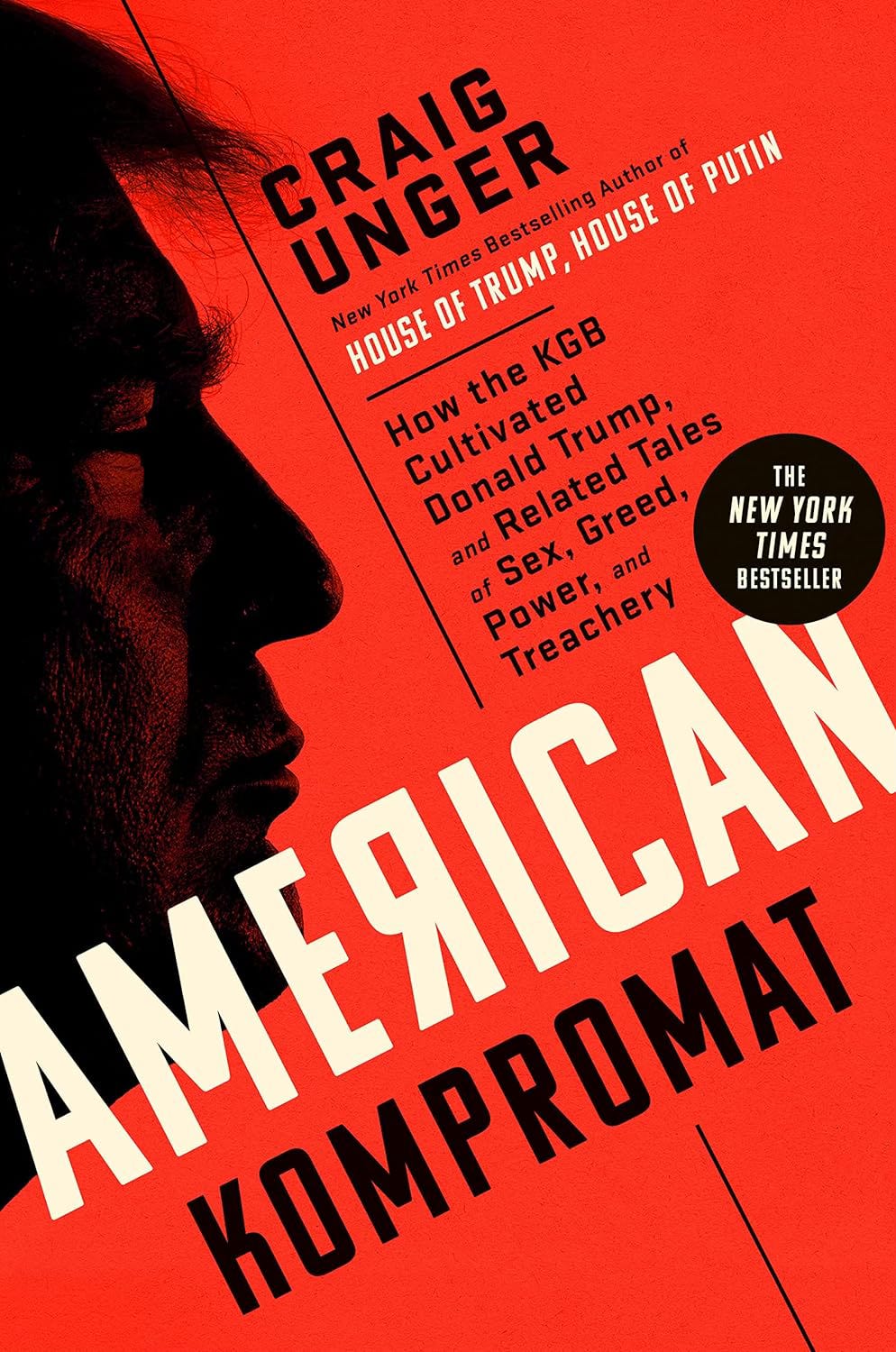
Investigative journalist Craig Unger, in his book American Kompromat, presents considerable evidence that Trump’s connection with Russia is a lot greater than financial ties. Unger’s thesis is that Russian intelligence has been using damaging information (kompromat) over time to leverage key players, and Trump could be among their greatest assets.
For instance, Trump’s original contact with the KGB and his classification as an asset is telling. The book also highlights Trump’s dependence on Russian oligarchs, as well as the reported systematic blackmail and potential Russian intelligence efforts aimed at getting Trump in sync with Kremlin agendas and the FBI investigation on Trump’s Russian connections and Trump’s administration’s distinctly pro-Russian policies.
Unger cautions us that Trump’s deferential treatment of Putin, denial of Russian election interference, and belittling of Western allies and NATO foretells actions serving Russian interests over American.
These disclosures of Trump’s involvement with Russia should serve as a wake-up call for every American. Trump’s willingness to compromise U.S. democracy, embolden dictatorships, and disregard intelligence advice is a dire threat to the country’s future. It is necessary to address foreign interference and psychological manipulation that has let a compromised leader get back into power in America, a free nation with imminent catastrophic consequences for citizens of the world.
Americans must better understand these issues, demand greater openness in U.S.-Russia relations, and hold leaders accountable.
This isn’t news. I’ve spoken about it for a while—but mainstream media has been slow to pick it up. Let’s not forget that I also wrote about the Mueller Report in The Cult of Trump. This vital investigation confirmed substantial Russian efforts at intervening in the U.S. election in 2016, including cyberattacks, disinformation on social media, and targeted releases aimed at sowing discord and benefiting Trump’s campaign. No direct conspiracy was established, but the report identified multiple connections between Trump’s campaign and Russian interests.
Trump’s alignment with Russian agendas is not only a matter of politics—it is a psychological and purposeful assault on the country’s roots in democracy. Trump’s anti-democratic approaches, in addition to financial and ideological ties with Putin’s regime, make him a threat to American democracy.
If we can’t intervene by massive coordinated effort, we risk:
•The erosion of democratic institutions.
•Increased susceptibility to foreign influence.
•The rule under authority made the norm.
My Call to Action:
I urge Americans to stay on guard from undue influence. Awareness is the first step in stopping excessive influence. Let’s pay attention to manipulation, keep politicians responsible, and help protect democracy.
We need community, strategic planning and implementation. We need hope and that will mean effort to counter the crisis we are in.
A former top KGB official, Airur Mussayev, claimed:
“In 1987, I worked in Moscow's 6th Department of the KGB of the USSR. That year, our department recruited the 40-year-old businessman from the USA, Donald Trump, nicknamed ‘Krasnov.’”
I recommend a couple of books in this area. First, “The Russian FSB: A Concise History of The Federal Security Service” By Kevin P. Riehle ©2024 (159 pages) — a dry little book. Sort of difficult to get through; a lot about the structure, organizational structure of Russia’s intelligence arm, the FSB —inheritor of the KGB. But good to have under the belt—a bit more clear on the FSB, some names. Connected to some of the previous readings. A more academic type of book.
Next, “The Moralist International: Russia in the Global Culture Wars” By Kristina Stoeckl and Dmitry Llzlaner, ©2022 (with after word after Russia’s invasion of Ukraine feb 2022) ( 156 pages) another dense, mean little book on Russia, the Russian Orthodox Church ; the Traditional Values movement in the U.S. especially and the transnational conserverative norm mobilization; How, ‘traditional’ ‘family’ values are/were imported from conservative groups in the U.S. post USSR collapse; these are not long held Russian historical values of thousands of years but recent; the stands on abortion, family, lgbtq, human rights, and after 2012, return of Putin, the Kremlin has led on this strategy of ‘traditional values’ and now is the Orthodox Church .. Putin, is leading the global discussion. Very very interesting and relevant, small dense book. correlates with Putin’s Dark Age; and mirrors the trend in the U.S. These are dangerous times, fraught.
Next, “Black Wind, White Show: Russia’s New Nationalism” new edition by Charles Clover ©2016 new edition ©2022 (332 pages) Saw/heard Clover speak somewhere .. and after the Trump book, which was about an awful person.. Then this book about terrible people, Putin, Alexander Dugin..but, what a an amazing book. It was so interesting. Such story from the origins of the concept of “Eurasianism” with Lev Gumilev to Alexander Dugin —the rise in the concept of Eurasianism which Putin et al have weaponized to rationalize Imperial USSR revanchist goals. Filling in the gaps as to how we got here. The strategy and thinking behind the attack on Ukraine. Who these figures are — some amazing background. How Putin was basically picked by a poll to succeed Yeltsin.. how Putin was like some fictional tv character that Russian’s liked. Dugin’s nazi youth past. His ambition for power. A lot of names we see surfacing elsewhere. It explains a lot and there are too many alarming similiarities between the harsh, hard-line rhetoric and bombast coming from our U.S. far right to be merely concurrence—coincidence.
And, ‘Putin’s Dark Ages: Political Neomedievalism and Re-Stalinization in Russia’ by Dina Khapaeva ©2024 (246 pages) a dense, mean, little book. And fascinating!