


There is a preponderance of reporting and commentary in the media describing Donald Trump’s hold on his supporters as a “cult of personality.” The phrase is now omnipresent, and points to Trump’s rallies, slogans, and the in-group loyalty that seems to survive most any political scandal as evidence.
However, this frame is incomplete, as seeing MAGA as a cult of personality puts only Trump at the center. He is no mastermind. In reality, a network of groups, each with its own leaders, money, and agenda, recruit and direct much of what is occurring.
Seen this way, Trump is the most visible part of the movement, not necessarily the most powerful and will affect how we explain the movement, and what we should expect after he is gone.
Why We Look at the Leader
The “romance of leadership,” described by Meindl and colleagues in 1985, is our tendency to credit or blame one leader for outcomes a larger system produces. The effect is strongest when outcomes are dramatic, which is also when news coverage tends to peak.
A related bias, the fundamental attribution error, leads us to explain behavior by personality rather than situation. Both pull attention toward one charismatic figure and away from the structures around him.
The Cult of Trump or MAGA is much larger than Trump as a figurehead. Cults are defined less by charisma or belief than by structure and control.
The Structure Behind the Leader
Most destructive cults share a pyramid structure with a leader at the top, an inner circle below, and rank-and-file members at the base. The graphic below, from The Cult of Trump, adds what the personality frame leaves out.
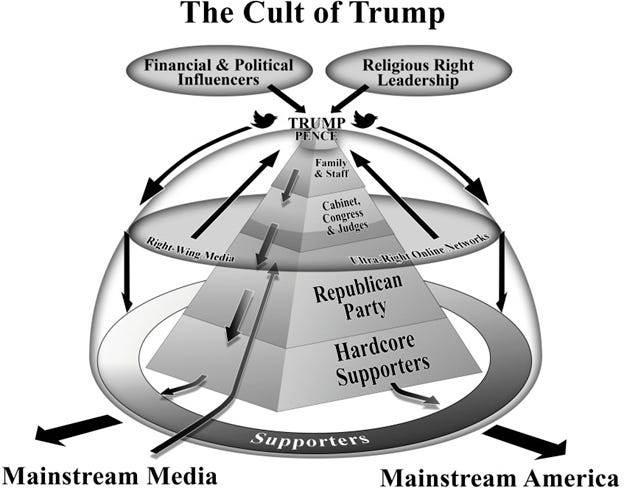
We should notice what sits above Trump in this framing — financial and political influence and religious right leadership, each feeding into the leader. By carrying messages to and from the leader and base, right-wing media and ultra-right online networks form a ring around the middle of the structure. Certainly not every supporter within MAGA belongs to the tier of hardcore followers — most occupy the outer rings — however, the core tiers are organized, and many were organized long before 2016.
Transferred Obedience
A key social psychology finding is that obedience follows perceived legitimacy. In Stanley Milgram’s studies, people deferred to authorities they saw as legitimate, entering what he called an “agentic state,” acting as instruments of another person’s wishes. When a trusted authority endorses someone new, that deference can transfer. Social rules or fears like not wanting to be rude or upset the experimenter can trap the person inside the agentic state
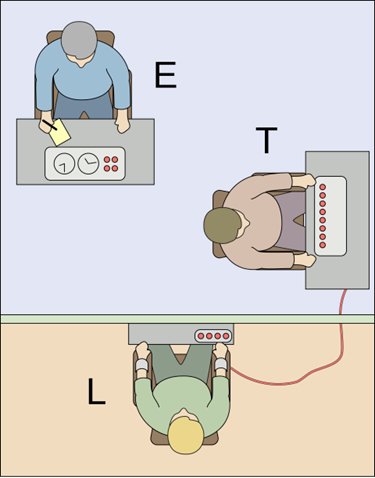
In Milgram’s famous experiment, the experimenter (E) tells the participant (T) to give painful electric shocks to another subject (an actor) to see if it will help him learn. When told to “continue” despite pleas to stop by the fake learner, many participants continued, despite feeling guilty. Milgram attributed their actions to the effects of an authority figure and the participant deferring personal responsibility to that authority.
Consider the New Apostolic Reformation (NAR), a network of Pentecostal and charismatic ministries led by self-appointed “Apostles” and “Prophets.”
According to former members and researchers, authoritarian NAR leaders claim to talk to God directly, and devotees’ loyalty is to the “Prophet.” Doubt is often recast as demonic influence, which shuts down questioning before it starts.
By those accounts, many NAR ministries fit the BITE Model of Authoritarian Control™ (Behavior, Information, Thought, and Emotional control). So, when charismatic Christian leaders declared Trump God’s choice (Lance Wallnau’s 2016 book cast him as a modern King Cyrus, an imperfect leader used by God to accomplish a specific deliverance or reset for a nation), the obedience was already in place. Many followers were prepared for Trump by their own leaders, which is worth considering given that many initial reactions to Trump amongst his base were skeptical.
Social exchange theory holds that relationships last as long as each side gets something of value and the Cult of Trump mobilizes on that logic. With the leader providing the stage, influencers provide money, a mobilized base, and a prepacked theology of his destiny.
Many movements back Trump because he advances their agendas, not only because of his personal pull or the commonly described “cult of personality.” To anyone who studies cults, the arrangement is familiar and comes about when allied groups elevate a figurehead while pursuing their own ends.
Borrowed Tactics
Outside actors have used the same methods. U.S. intelligence agencies documented a Russian influence operation during the 2016 election. The operation relied on trolls, bots and used fake American identities, invented enemies, fear, and us-versus-them division. Russia recruited Trump as an “asset” in 1987 according to Yuri Shvets, former KGB official in Craig Unger’s book, American Kompromat.
Social identity theory shows that sharpening the line between “us” and “them” strengthens in-group loyalty and hostility toward outsiders while the illusory truth effect shows that repeated claims come to feel true. All the while, the troll farms complete with manufactured identities created social proof and seemed to demonstrate people like me already believe this.
The web of influence now includes technology wealth. The Cult of Trump flagged libertarian billionaires such as Peter Thiel, and the Cambridge Analytica scandal, which harvested data on 87 million Facebook users for political targeting.
The scale has since grown when the crypto industry’s Fairshake super PAC spent about $196 million on congressional races. The reciprocity norm predicts that large gifts create a felt obligation to return the favor.
In 2024, U.S. intelligence assessed that China was not trying to directly sway the presidential race. Instead, it targeted candidates it saw as threats and promoted negative stories about both parties. Its “Spamouflage” network posed as American voters, some as Trump supporters, to amplify divisive issues.
This influence by China and Russia leave Americans exposed to undue influence. If this is a cult of personality, it ends with Trump. If it is a network, the structures will outlast him. The communities existed before Trump, and they will look for their next figurehead. If we map control across a whole network, not just around a single charismatic leader, we can recognize the same patterns wherever they reappear.
Discover Similar Topics


References
Hasher, L., Goldstein, D., & Toppino, T. (1977). Frequency and the conference of referential validity. Journal of Verbal Learning and Verbal Behavior, 16(1), 107–112.
Hassan, S. (2019). The cult of Trump: A leading cult expert explains how the president uses mind control. Free Press. (Reissued 2024 with a new afterword.)
Homans, G. C. (1958). Social behavior as exchange. American Journal of Sociology, 63(6), 597–606.
Meindl, J. R., Ehrlich, S. B., & Dukerich, J. M. (1985). The romance of leadership. Administrative Science Quarterly, 30(1), 78–102.
Milgram, S. (1974). Obedience to authority: An experimental view. Harper & Row.
U.S. Senate Select Committee on Intelligence. (2019). Russian active measures campaigns and interference in the 2016 U.S. election, Vol. 2: Russia’s use of social media.
Wallnau, L. (2016). God’s chaos candidate: Donald J. Trump and the American unraveling. Killer Sheep Media.
So many people do not know about or understand social psychology. The influence it has is tremendous and so it is extremely important to learn and be cognizant of where it leads. Sometimes it can work for good, sometimes not. Be aware and beware.